The Global Matcha Boom and the Crisis It's Causing
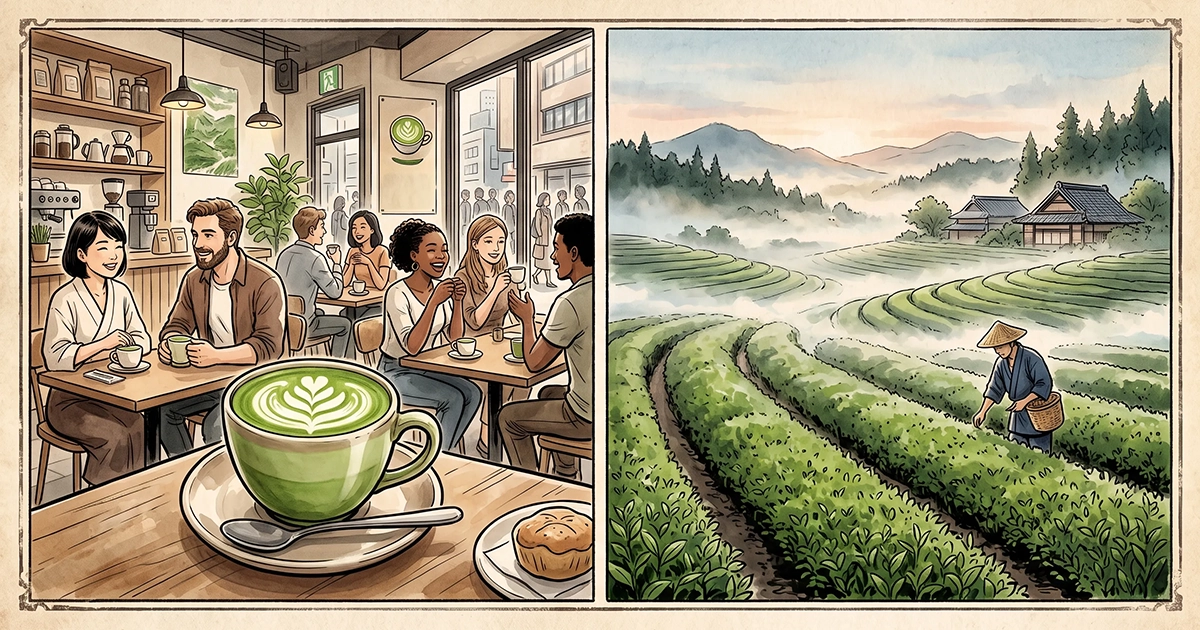
Last updated: August 2026
The Numbers Behind the Boom
According to Japan's Ministry of Agriculture, Forestry and Fisheries, green tea exports in 2025 reached approximately ¥72.1 billion (around USD 490 million), a year-on-year increase of 98.2%. Powdered green tea, including matcha, accounted for 84% of total green tea export value and 69% of export volume, indicating it was the primary driver of growth, though the 84% figure reflects its share of total export value, not the share of the year-on-year increase attributable to matcha alone.
(6th consecutive record high) Ministry of Agriculture, Japan
(nearly doubled in one year) Ministry of Agriculture, Japan
by powdered green tea Ministry of Agriculture, Japan
the market in 2025 (1 bankruptcy,
13 closures or dissolutions) Teikoku Databank
The United States remains the largest market (¥29.3 billion, up 82.6%), while the UK recorded a staggering 403.9% increase, meaning exports to Britain grew to more than five times their previous year's value. This isn't a trend confined to food enthusiasts. Matcha has crossed into the mainstream.
The Supply Crisis Nobody Is Talking About
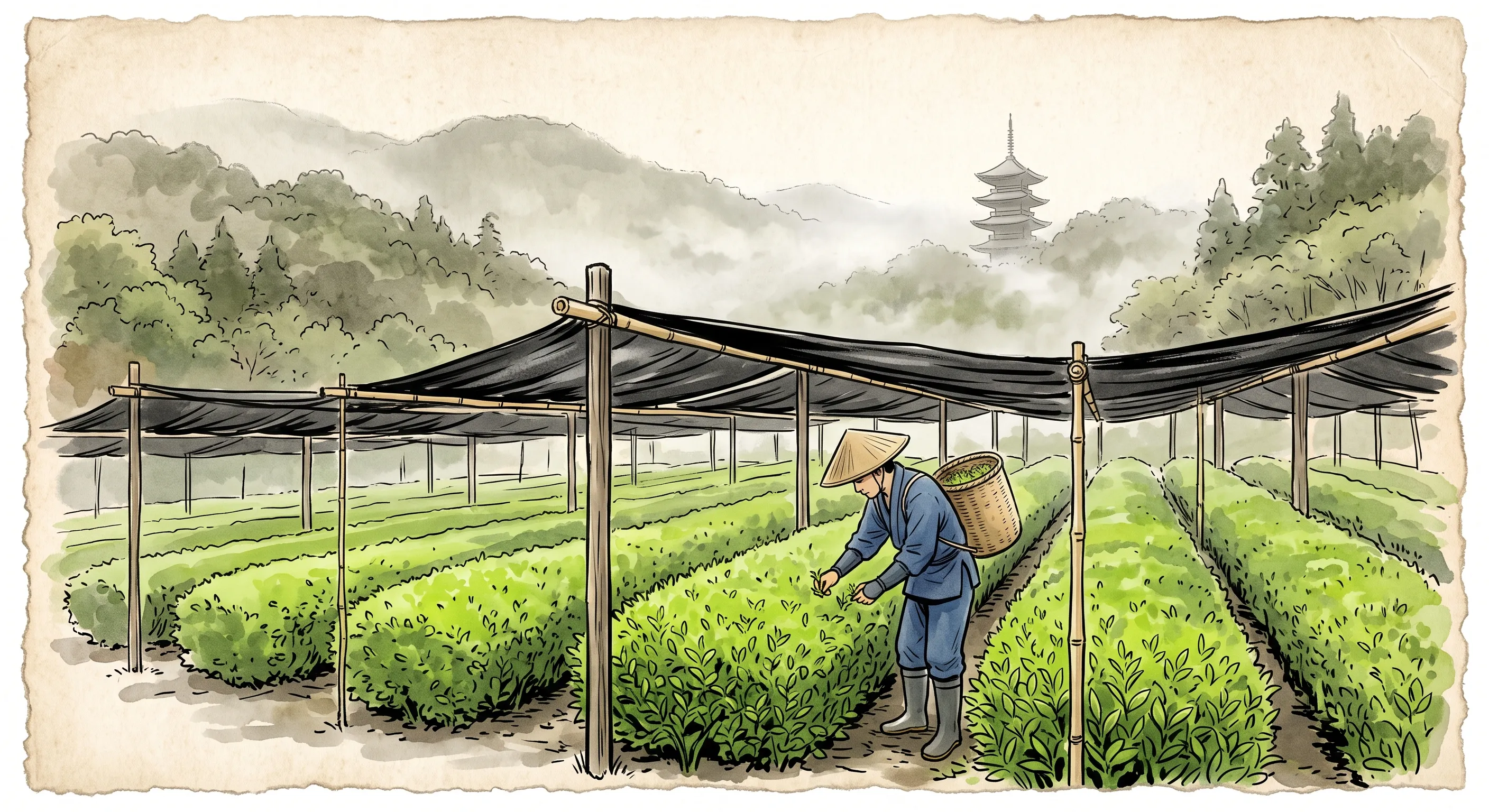
Tencha — the shade-grown tea leaf that becomes matcha — requires weeks of careful covering before harvest. Farmers are converting to it rapidly, but replanted tea fields require several years before they return to commercially meaningful yields.
The raw material for matcha is called tencha, tea leaves grown under shade covers to concentrate umami and chlorophyll. According to the Norinchukin Research Institute, the farmgate price of tencha was already 2.7 times higher than that of standard sencha as of 2024. That gap has since widened. Farmers across Uji (Kyoto), Nishio (Aichi), and Yame (Fukuoka) have been rushing to convert their fields. Tencha production has grown 2.8 times over the past fifteen years. Yet according to Japan's Ministry of Agriculture census data, the number of farming operations growing tea for commercial sale fell by approximately 40% in just five years — from 2015 to 2020 — dropping to 5,827 operations nationwide.
But here is the structural problem: replanted tea fields require several years before they return to commercially meaningful yields, the exact timeline depends on cultivar, site, management, and the target harvest. No matter how powerful the demand signal, the land cannot respond quickly enough. Supply has been chronically short, and what little stock exists commands extraordinary prices.
Converting to tencha production is also far from straightforward. It requires specialized shade-covering infrastructure, dedicated drying kilns, and processing equipment, investments that run into the tens of millions of yen even for a modest-scale operation. For aging farmers already stretched by years of declining domestic demand, this barrier is effectively insurmountable. Many are choosing to exit the industry rather than take on the debt.
In some Shizuoka tea markets, reports have described unusual price inversions in which the price of autumn-flush tea — historically the cheapest grade — has surpassed that of first-flush new tea, the most prized harvest of the year. We have not independently verified the full historical extent of such inversions across the Japanese tea trade.
Sencha vs. Tencha: Wholesale Price Comparison (2024)
Source: Norinchukin Research Institute, "Matcha Boom and Sencha Price Surge" (May 2026) / Japan Tea Industry Central Association
This price gap is driving the rush to convert fields from sencha to tencha production.
The ripple extends beyond the farm gate. Wholesalers are rationing stock. Long-standing supply relationships between tea farmers and processors are breaking down as growers chase better prices elsewhere. What was once a stable, seasonally predictable market has become something closer to a commodity auction.
Sencha Is Paying the Price
While the matcha story is being told as a triumph, there is a quieter story unfolding alongside it, one that we are living through directly as a tea retailer.
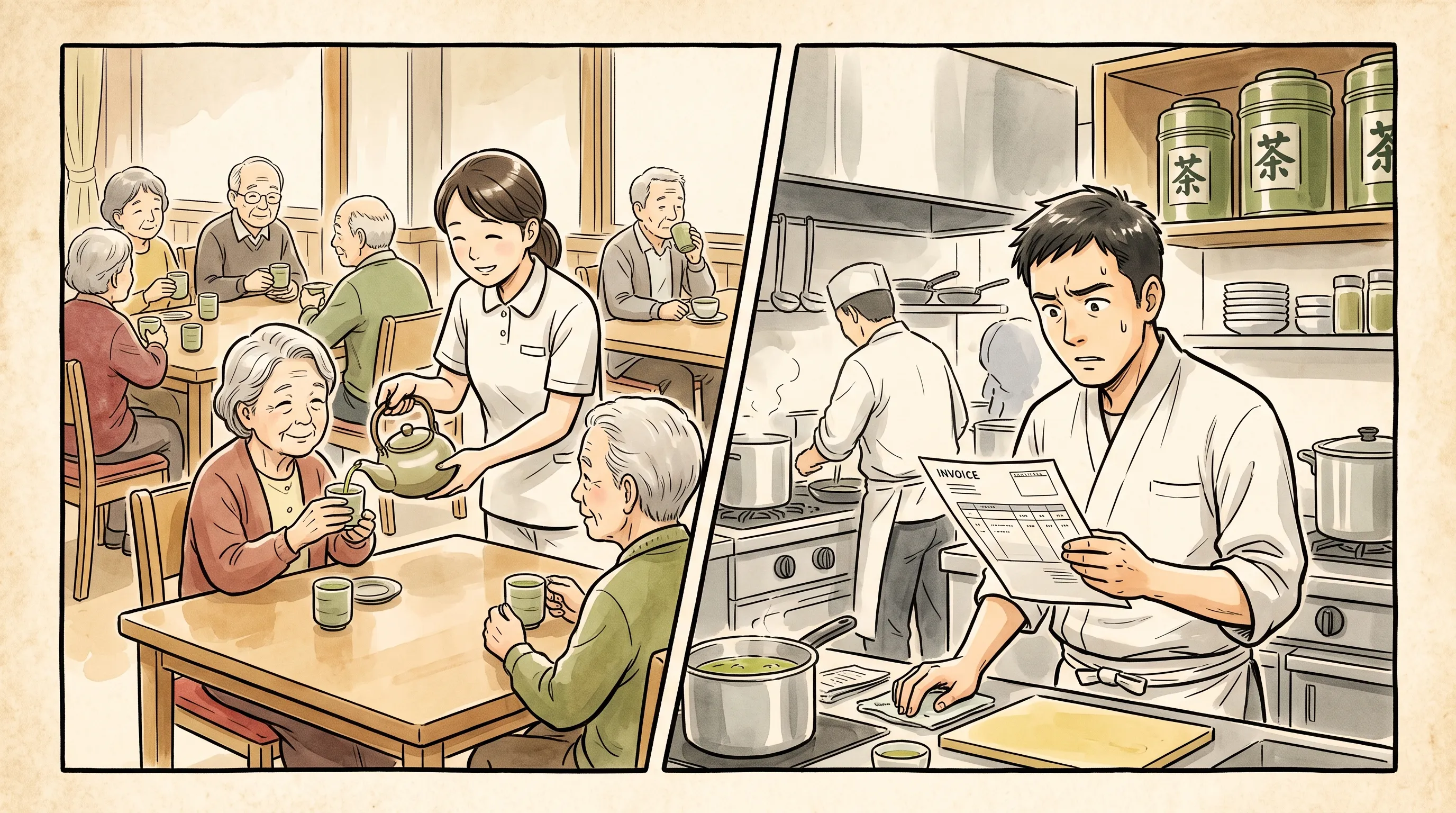
Care homes, restaurants, and traditional inns brew large quantities of green tea every day. For these institutions, the doubling of wholesale prices has become a serious operational burden.
The shift to tencha production, combined with an aging farming population and a wave of retirements with no successors, has dramatically reduced the supply of everyday sencha, particularly the affordable grades used in bulk by institutions. Our wholesale prices for lower-grade teas have more than doubled in the past year. The customers hit hardest are the ones who can least afford it: nursing homes, hospitals, restaurants, and traditional inns that brew large quantities every single day. We've chosen to absorb as much of the cost increase as we can rather than pass it on in full, but the margins have become extremely tight. And some products we used to carry simply no longer exist, the farms that made them have either switched crops or shut down entirely.
According to Teikoku Databank, 2025 saw 14 Japanese tea-processing businesses exit the market, including one bankruptcy and 13 closures or dissolutions. The available cases suggest that tea processors with access to tencha-related equipment or supply relationships may be better positioned, while some conventional sencha processors are facing higher procurement costs. The data does not establish a uniform two-way split across the entire industry.
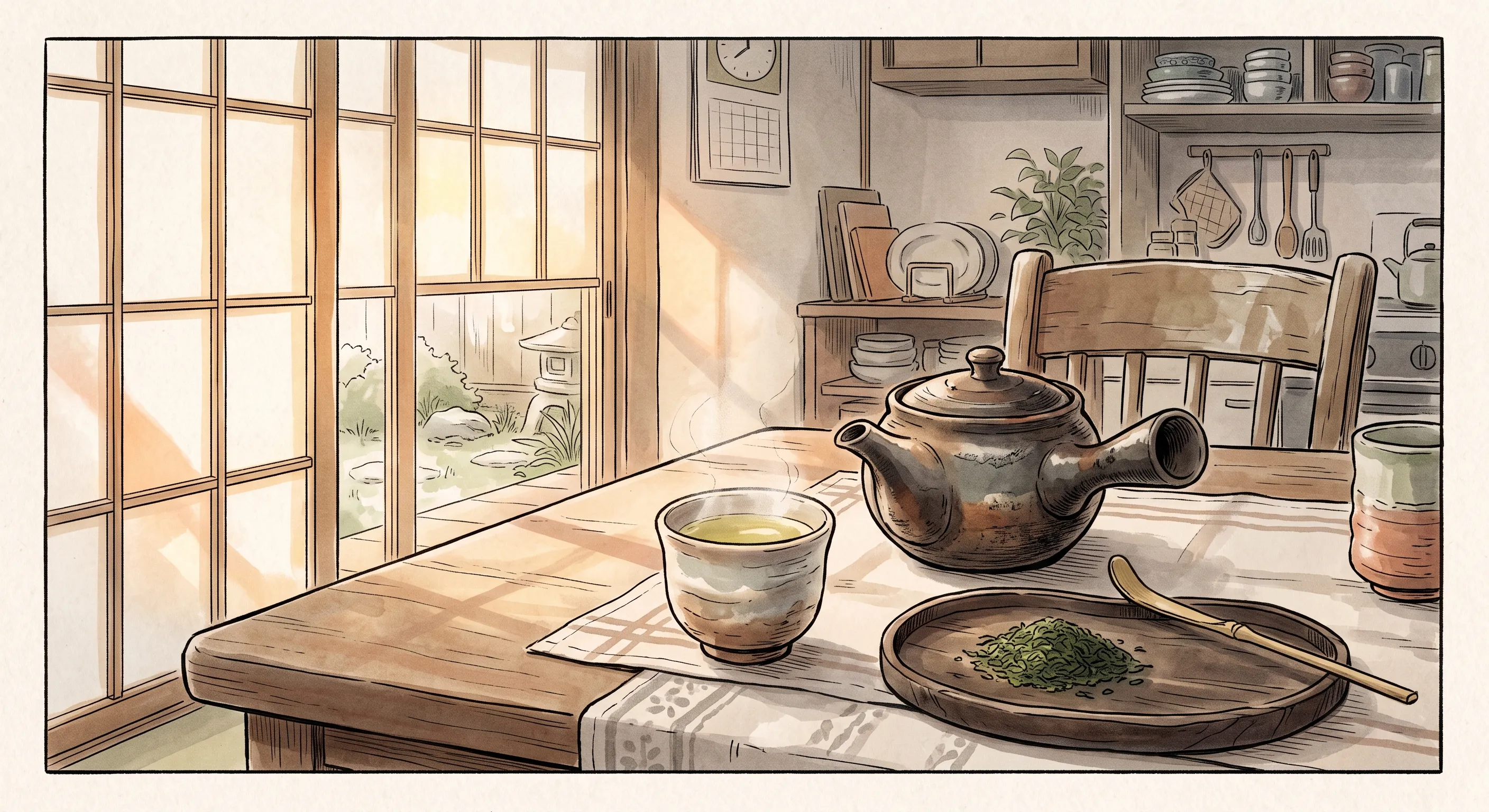
Brewing a pot of sencha at home — one of the most ordinary rituals of Japanese daily life — is becoming an unaffordable luxury for some, and a forgotten habit for others.
The underlying mechanics are straightforward. Matcha, sencha, gyokuro, bancha, and hojicha all come from the same plant, Camellia sinensis. What separates them is how they are grown, when they are harvested, and how they are processed. When farmers redirect their land toward tencha, the supply of every other category contracts. The price ripple is felt across the entire market.
If this continues, brewing loose-leaf sencha at home — something ordinary Japanese families have done for centuries — risks becoming either a luxury or a relic. The irony is considerable: at the very moment the world is discovering Japanese tea, the Japanese themselves may be priced out of their own tradition.
What You're Drinking May Not Be What You Think
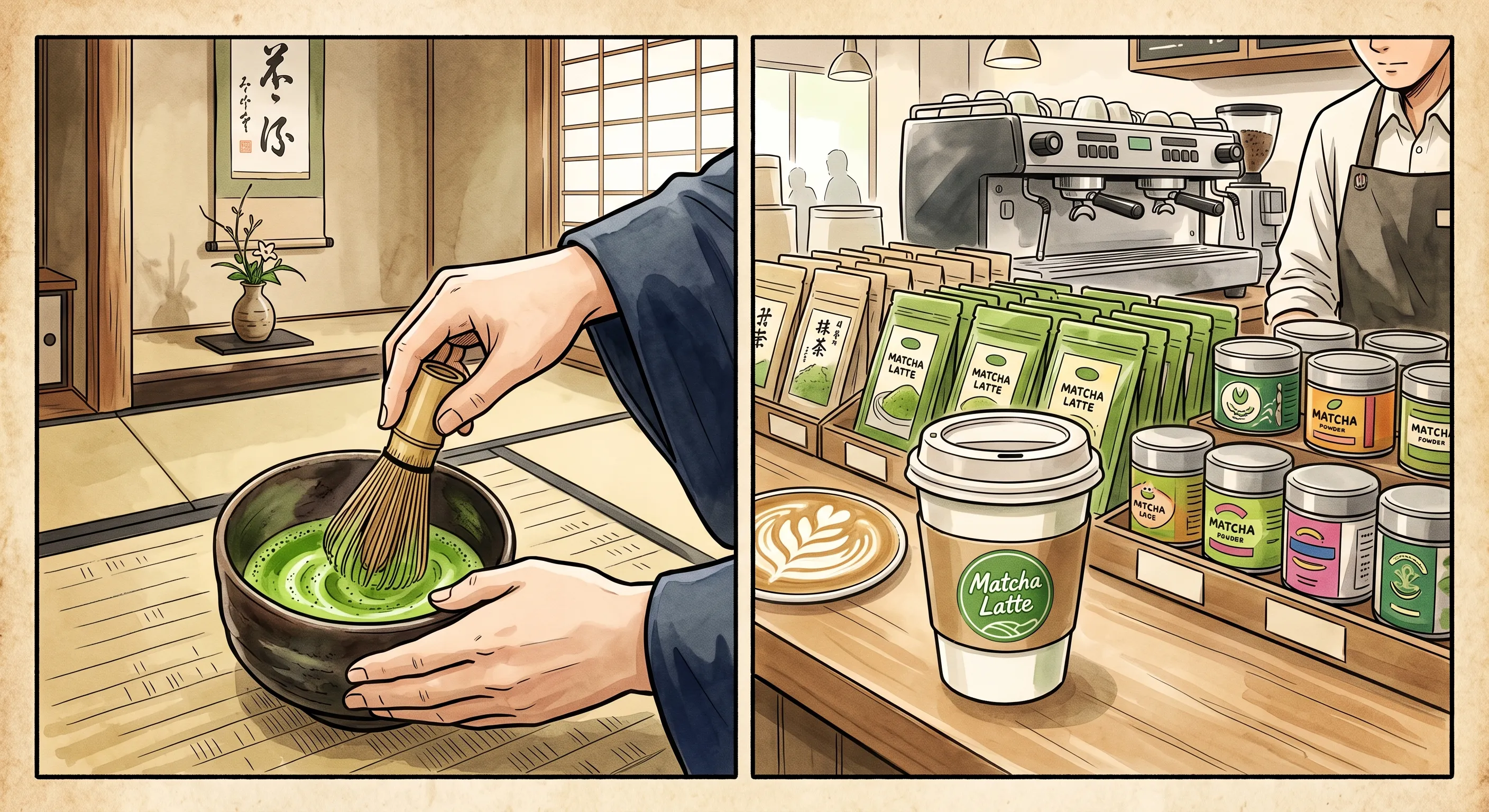
Authentic matcha, prepared in a traditional tea ceremony, and the commercial "Matcha" now found on café menus worldwide are very different things, in origin, in grade, and in purpose.
Much of what is sold internationally as "Matcha" bears little resemblance to the product that Japan's tea culture was built around. Lower-priced powdered green-tea products from China and other producing countries are widely available in international markets. Their prices cannot be meaningfully compared with Japanese matcha without controlling for raw material, purity, grade, packaging, volume, and distribution stage, but the price gap can be substantial, and the products are often indistinguishable to the untrained eye.
There is a further problem that deserves more attention than it typically receives: the term "ceremonial grade" is widely used as a commercial or marketing designation rather than as a standardized quality grade. In the Japanese and US standards we reviewed — including Japan's JAS framework and USDA definitions — we found no internationally recognized quality grade corresponding to "ceremonial matcha." Without a regulated definition, the label can be applied broadly. In a market as overheated as this one, products that professional tea buyers would classify as culinary or latte grade are sometimes being sold as "ceremonial" at premium prices. Buyers are advised to verify origin, ingredients, production method, and testing records rather than relying on the label alone.
But there is a subtler confusion that is perhaps more important to address: the difference between genuine matcha and funmatsucha, ordinary powdered green tea. Real matcha is made exclusively from tencha: shade-grown, carefully harvested tea leaves stone-ground into a fine powder. Funmatsucha is made from regular sencha or bancha that has simply been dried and powdered. The flavor, the color, and the nutritional profile are quite different.
Here is what concerns us most: many visitors to Japan — and even many Japanese people — do not know this distinction. The green powder served at conveyor belt sushi restaurants and budget cafeterias is often a sencha-based powder or a blended product rather than genuine matcha, though the exact composition depends on the supplier. Visitors who try it, enjoy it, and go home believing they have experienced authentic Japanese matcha may be forming an inaccurate impression, and the cumulative effect on Japan's tea reputation is real.
We stopped carrying matcha years before the current boom, long before it became difficult to source. Even then, the economics didn't work for a small retailer: authentic Kyoto-grown matcha has a short shelf life, it requires careful storage, and the price point makes it hard to compete with larger operations. Since the boom, sourcing quality matcha from Uji has become genuinely difficult, and the margins, if you can get stock at all, are negligible. Matcha has effectively become a product that no longer belongs on the shelf of an independent tea shop alongside everyday sencha.
Within the category of genuine Japanese matcha, a further distinction matters, particularly for buyers in the food and beverage industry. Ceremonial-grade matcha tends to be richer in theanine (the amino acid associated with umami and the calm focus tea drinkers prize) and is intended to be whisked with hot water and drunk as-is. Latte-grade or culinary-grade matcha typically has a higher catechin content, that slightly bitter, vegetal character that can hold its own against milk and sugar. For many cafés, a culinary or latte-oriented matcha may offer a better balance of flavor, color stability, and cost in milk-based drinks. Whether using a high-grade ceremonial matcha in a latte represents a mismatch of product and purpose is ultimately a product and taste judgment, but it is worth understanding the difference.
Indicative online prices observed in selected markets (USD/kg)
The ranges combine selected small-lot retail and bulk-wholesale listings and are not directly comparable. Retail, wholesale, and export-average unit prices can differ substantially.
| Category | Typical price (per kg) | What to check |
|---|---|---|
| CeremonialFor drinking as-is | $100 – $300+ / kg(small-lot retail; varies widely) |
|
| Latte / culinaryFor mixing with milk, baking | $25 – $70 / kg(bulk wholesale; add-on at retail) |
|
| Low-price "ceremonial"Labeled ceremonial, priced low | Under $50 / kg(as "ceremonial", warrants scrutiny) |
|
| FunmatsuchaPowdered green tea, not matcha | Variable(common in Japanese restaurants) |
|
Note: "Ceremonial grade" is a marketing term with no legal definition under JAS, USDA, or any regulatory body.
Prices reflect small-lot retail; bulk wholesale and export average unit prices differ significantly.
Source: Minorien, based on publicly available market data as of August 2026.
The Case for Sencha
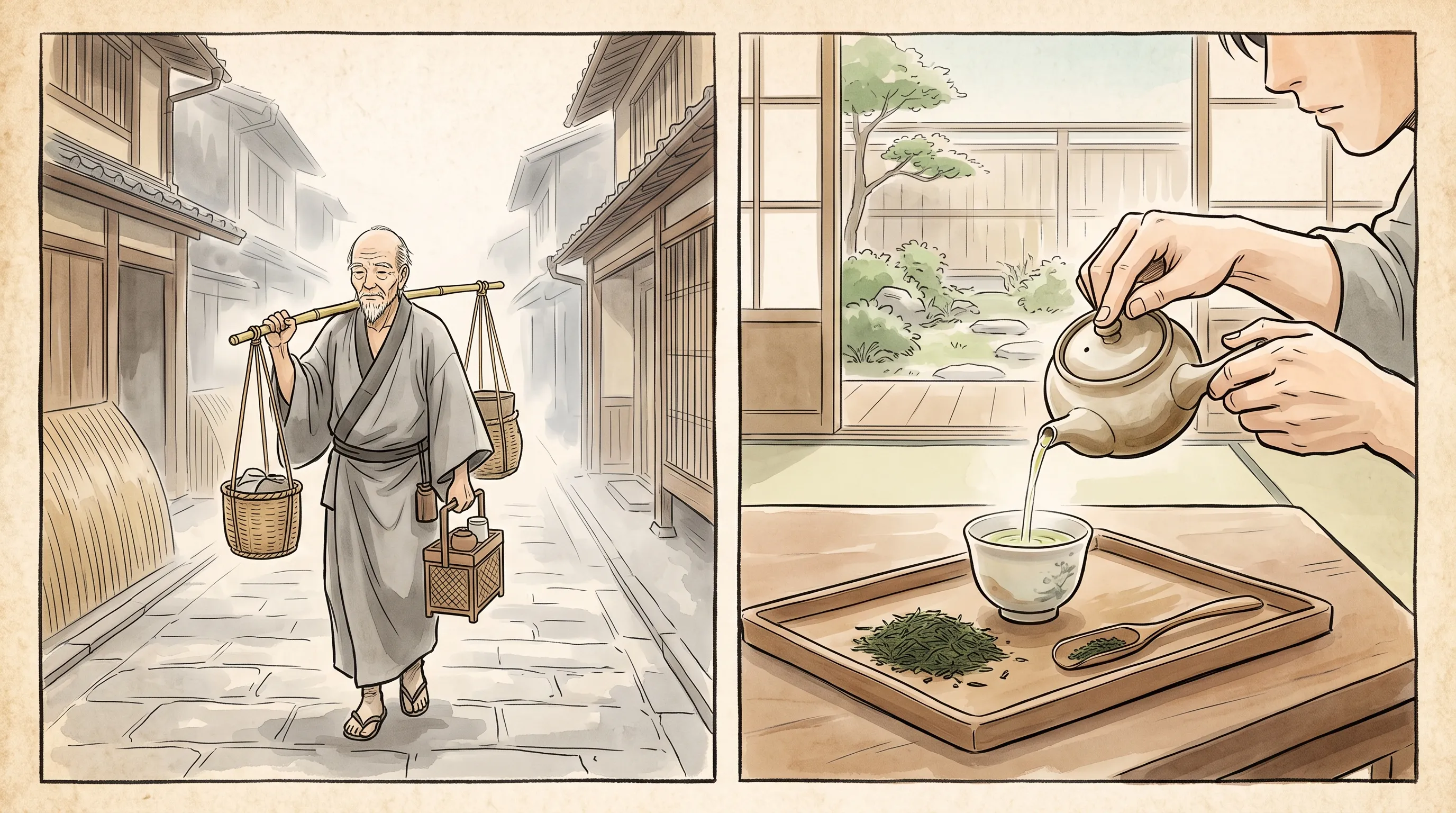
Baisaou in eighteenth-century Kyoto, and a cup of sencha being brewed today. The act of making tea carefully — and the clarity it offers — has not changed in three hundred years.
There is a figure from eighteenth-century Kyoto who feels unexpectedly relevant right now. Baisaou — the "Tea-Selling Hermit" — was a Buddhist monk who gave up a prestigious position within the Ōbaku Zen order to sell tea from a portable stall on the streets of the city. He charged whatever people could afford, or nothing at all. He called what he sold not "tea" but seifū, "a clean breeze." His point was that the value of tea lay not in its price or its ceremony, but in the moment of clarity it offered to whoever was drinking it.
If you enjoy a matcha latte, that is a perfectly good place to be. Matcha has introduced millions of people to Japanese green tea, and that is genuinely worth celebrating. But matcha — especially in its current commercial form — is only one part of a much larger story. Sencha, brewed carefully in a small teapot, offers something different: a subtlety of flavor, a quietness of experience, and a connection to a tradition that goes back centuries. It is not better than matcha. It is simply deeper.
The matcha boom has, paradoxically, created a real opening for sencha. The world now knows that Japanese green tea is worth seeking out. The next step — discovering what a well-brewed sencha actually tastes like — is one that anyone who loves matcha is already well-placed to take.
We continue to carry sencha at prices we can justify, even as our margins have compressed. It matters to us that our customers can still afford to brew a proper cup at home. The ritual of making tea — warming the pot, measuring the leaves, waiting — is not a luxury. It is one of the simplest and most reliable ways we know to slow down. That is what we want to protect.
Japan's tea culture has never been a single thing. It has always been a spectrum, from the formal precision of the tea ceremony to the casual cup poured from a kitchen kettle. Keeping that full spectrum alive, rather than reducing "Japanese tea" to a single powdered export commodity, seems to us like the most important work of the next decade.
A Note on How to Read This Article
We have tried to be honest about what we are seeing as a small, independent tea retailer, not as industry analysts or government spokespeople. Statistics in this article are drawn from publicly available data published by Japan's Ministry of Agriculture, Forestry and Fisheries, Teikoku Databank, and the Norinchukin Research Institute. The observations about our own business are exactly that: our own.
If you came to this article as a matcha lover, we hope it has added something to your understanding rather than taken anything away. And if it has made you curious about sencha — about what Japanese green tea tastes like when it is brewed slowly, in a small pot, with water that is not quite boiling — that curiosity is exactly where we would like to leave you.
 Shop
Shop