When Rock Stars Unplugged and Found Tea
——The Beatles, the Sixties, and the East
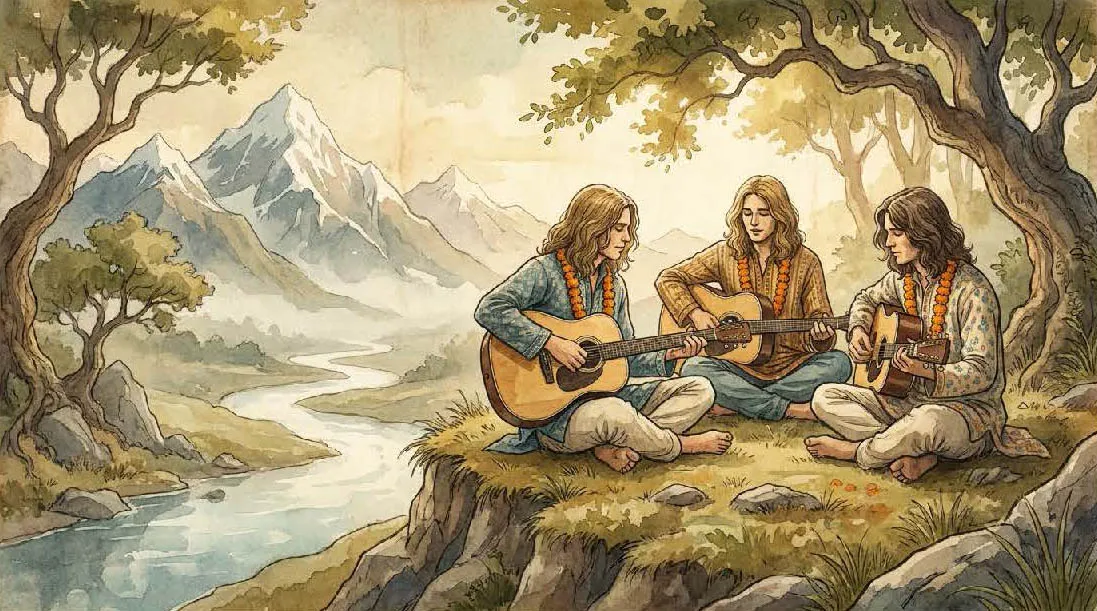
▲ Illustrated scene: high above the Ganges, adorned with marigolds, the biggest pop stars in the world unplugged
Into the Silence — The Decision of 1968
In mid-February 1968, one of the world's most successful pop groups left London behind. The Beatles — John, Paul, George, and Ringo — did not fly to a glamorous stage or a state-of-the-art recording studio. They flew to Rishikesh, a small town in northern India, and made their way to a meditation ashram perched on a cliff 150 feet above the Ganges.
After a twenty-hour journey, they were met at Delhi airport by a crush of reporters and photographers, along with red and yellow marigold garlands draped around their necks.
The Beatles were, at that moment, exhausted. The year before, they had lost Brian Epstein — their manager and emotional anchor — to a sudden death. The machine of commercial pop music was consuming them. Led by George Harrison's deepening conviction, they had turned to Transcendental Meditation as a way out: something beyond drugs, beyond performance, beyond the noise.
At the ashram, they found company: the singer-songwriter Donovan, Beach Boys member Mike Love, actress Mia Farrow, and others, all searching for something the mainstream world seemed unable to give them. Without electric instruments, they gathered around acoustic guitars and played simply.
What they found there was silence — radical, almost shocking silence: sitting still, turning inward, and stepping away from the noise of everyday life. That silence turned out to be extraordinarily productive. In Rishikesh, they wrote dozens of songs that would eventually make up the White Album, including "Mother Nature's Son," "Dear Prudence," "Julia," and the song that would become "Jealous Guy."

▲ Illustrated scene: Mario Savio at UC Berkeley, 1964 — calling on a generation to throw themselves against the machine
Dropping Out of the Machine — The Body's Rebellion
What drove young people in the late 1960s was not simply a taste for rebellion. It was a deep, physical revulsion at a society that had become a machine: standardized, accelerating, optimized for productivity and consumption at the expense of everything else.
Faced with this machine, young people reached for something they felt mainstream Western society could not offer them: Zen, Taoism, and other strands of Eastern philosophy. Not dogma. Not institutions. Just the idea that truth could be found in the simplest daily acts: in breathing, in sitting, in making a cup of tea. Tea had long been associated with meditation in Zen practice. That connection made it a natural bridge between Eastern philosophy and everyday life.
For many of these young people, brewing tea and drinking it quietly seems to have become more than a habit — a way of switching the machine off, briefly and deliberately, and letting the noise inside their heads settle. In today's language, we might call it mindfulness. In the 1960s, they simply called it dropping out.
This spirit — stepping back from the system and finding freedom in a single cup of tea — resonates, across centuries, with the life of Baisaou, the eighteenth-century tea seller and former Zen monk who abandoned an institutional career to sell sencha on the streets of Kyoto. The parallel is not historical. There is no direct connection between Baisaou and the 1960s counterculture. But the attitude is strikingly similar: step away from the apparatus, make tea, and talk to people as equals.
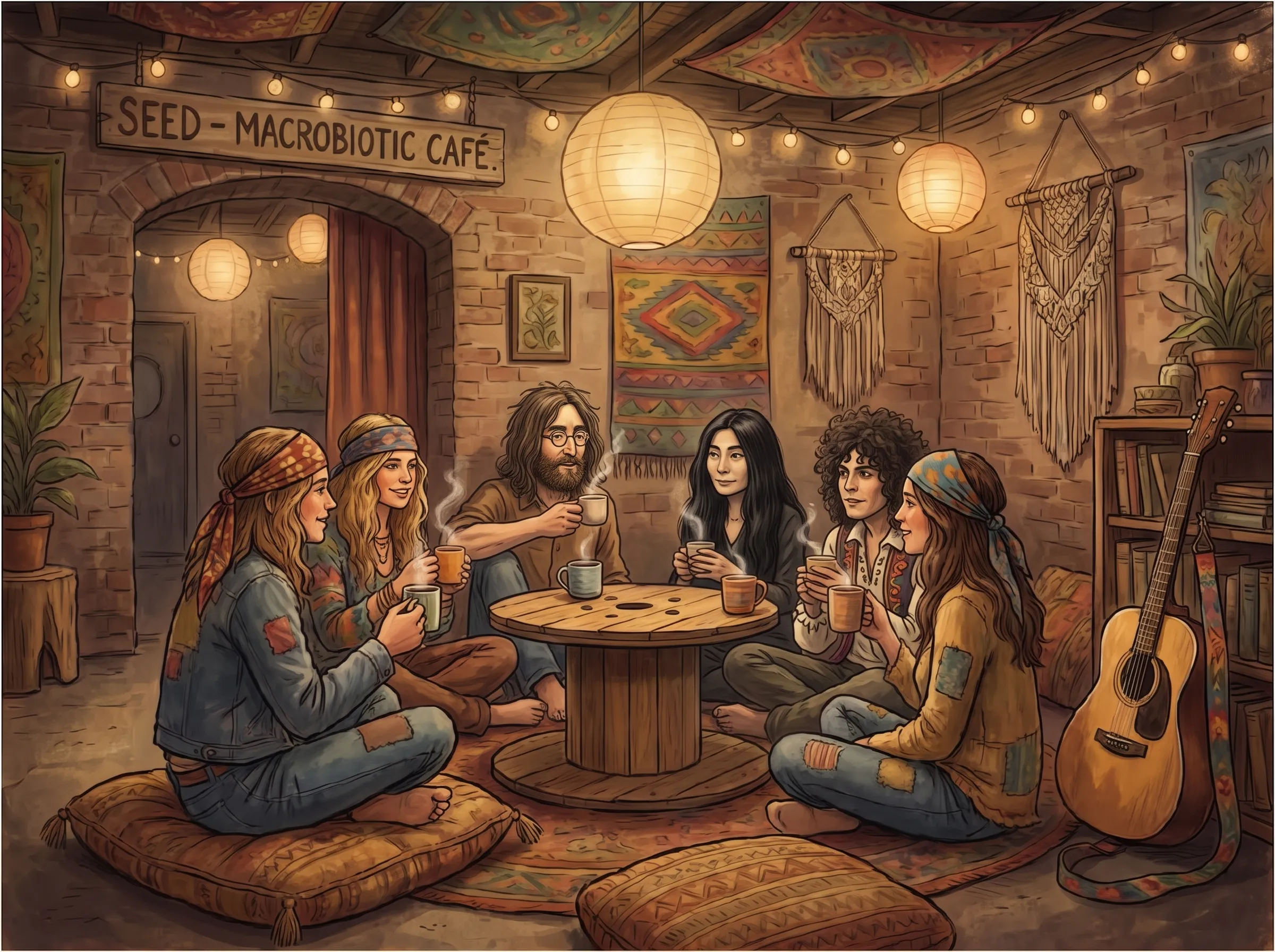
▲ The Seed café, London — sitting on the floor, around repurposed cable drums, drinking unsweetened tea
The Seed Café, London — A Quiet Rebellion Against British Tea
In Britain, where tea was deeply embedded in everyday life, for parts of the counterculture, the conventions surrounding "proper tea" — its rules and rituals, its milk and sugar and bone china — could feel inseparable from the establishment they wanted to question.
They turned instead to simple Japanese teas — unsweetened green tea, roasted bancha, and genmai-cha. Tea that required no elaborate ceremony, no inherited rules, just hot water, leaves, and time.
At the center of this shift were two brothers: Craig Sams and Gregory Sams, who would go on to become legends of the British organic food movement.
In 1965, Craig Sams was traveling what would later be called the Hippie Trail. In Kabul, Afghanistan, he fell gravely ill: amoebic dysentery and infectious hepatitis. What saved him, he later wrote, was the local approach: simple whole-grain flatbread and strong unsweetened tea. The experience convinced him that food, tea, and physical health were inseparable, and pointed him toward the philosophy of Zen macrobiotics, as developed by the Japanese thinker George Ohsawa (Sakurazawa Nyoichi).
In macrobiotic thinking — which classifies foods and drinks along a "yin and yang" axis, a framework describing their warming or cooling energetic qualities — unfermented green tea was considered strongly "yin": cooling, and not always ideal for the body. Preferred teas were more heavily roasted: three-year bancha, genmai-cha with its toasted rice. These were "yang" teas: warming, grounding, suited to a body trying to find balance.
In late 1967 and early 1968, the Sams brothers opened Seed — a macrobiotic restaurant near Paddington in London that became a gathering place for London's alternative scene. The space looked like nothing else in the city. Chairs were abolished. Enormous wooden cable drums — the kind used to spool industrial wire — became round tables. Customers sat on cushions on the floor around them.
John Lennon and Yoko Ono came to Seed. So did Marc Bolan of T. Rex, who, according to Craig Sams' own account, met Mickey Finn there, leading to the formation of T. Rex as a band. These figures sat on the floor, shared unsweetened tea, and, in doing so, stepped outside the conventions of the British establishment. Simply sitting on the floor, holding a cup of tea in both hands, was already a rejection of the conventions they had grown up with.
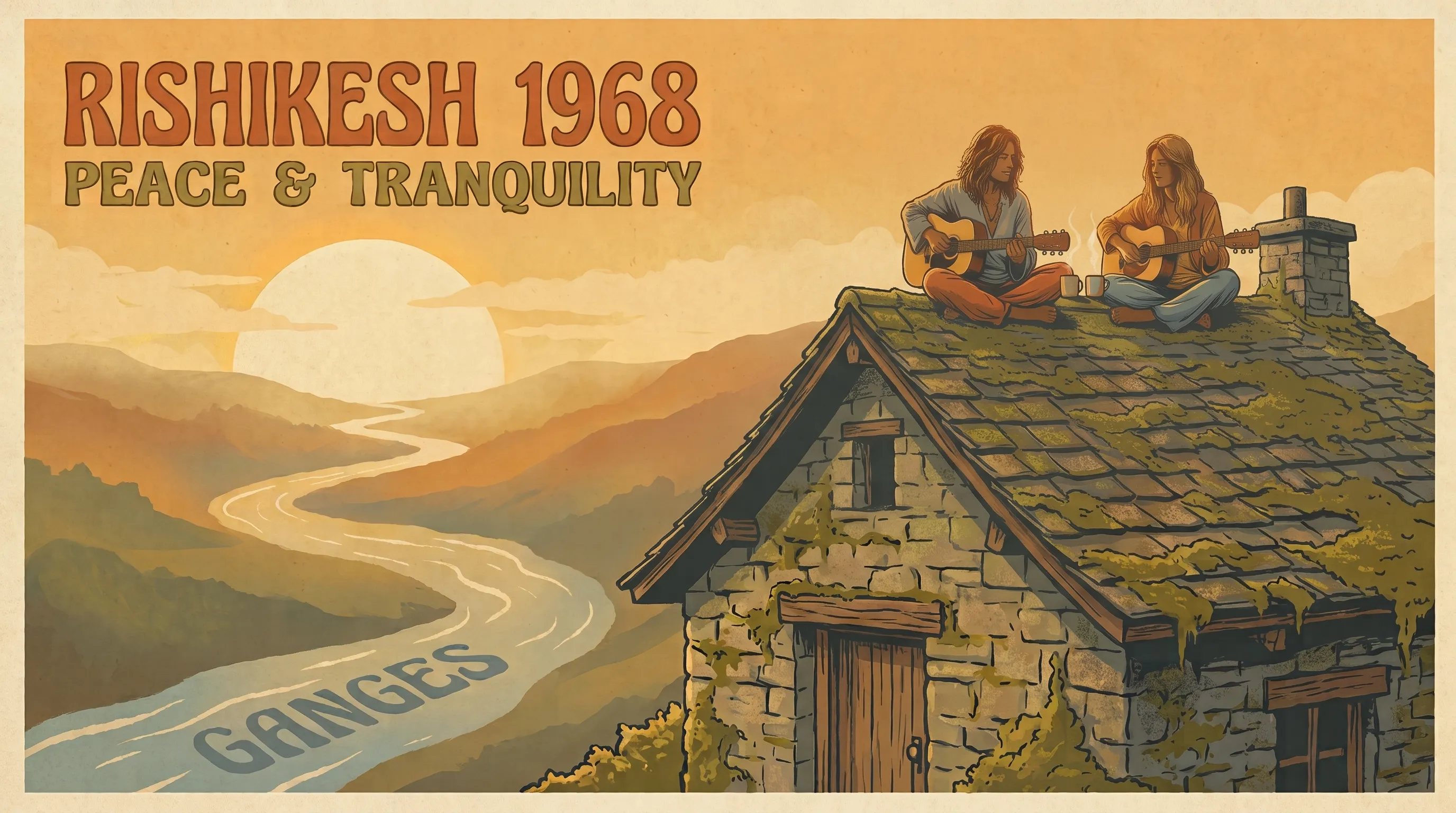
▲ Rishikesh, dusk — on a rooftop above the Ganges, an acoustic session that would change rock music
Rishikesh, Unplugged — The Silence That Made the White Album
The ashram of Maharishi Mahesh Yogi stood on a cliff above the Ganges, surrounded by lush greenery and far removed from the outside world. Pop stars who had spent years in the machine of the entertainment industry arrived here and found a radically different rhythm: meditation, simple vegetarian meals, and long stretches of quiet.
George Harrison later described the Beatles as having achieved extraordinary wealth and fame during those years, without finding the love, health, or inner peace they had hoped those things would bring.
There were no electric amplifiers at the ashram. No drum kits. The musicians had only acoustic guitars and whatever instruments they could find locally. Stripped of electronics, they turned to hand-clapping, tabletop rhythm, and silence itself as musical material.
In the evenings, artists gathered on the cottage rooftops. They could hear the Ganges flowing far below. Donovan taught John Lennon a fingerpicking technique — three-finger picking, gentle and intricate — and Lennon picked it up quickly. Out of it came "Julia," written for his late mother, and "Dear Prudence," written to coax Prudence Farrow out of her room where she had been meditating for days.
Paul McCartney's "Mother Nature's Son" came from a Maharishi lecture about returning to nature. John Lennon wrote "Child of Nature" from the same lecture. It was left off the White Album, surfaced again three years later as "Jealous Guy" on the Imagine album, with completely rewritten lyrics. These songs shared a quality that was new in the Beatles' catalogue: spare, unadorned, inward. Nothing like the overloaded psychedelia of Sgt. Pepper's.
The Beatles wrote more than thirty new songs in Rishikesh (some accounts say forty-eight). The restrictions — no electricity, no studios, little to do but sit and think — gave the songs room to breathe. Tea may have been part of the atmosphere of quiet and simplicity surrounding that experience, offering a reason to pause and something warm to hold — though the evidence does not allow us to say more than that.
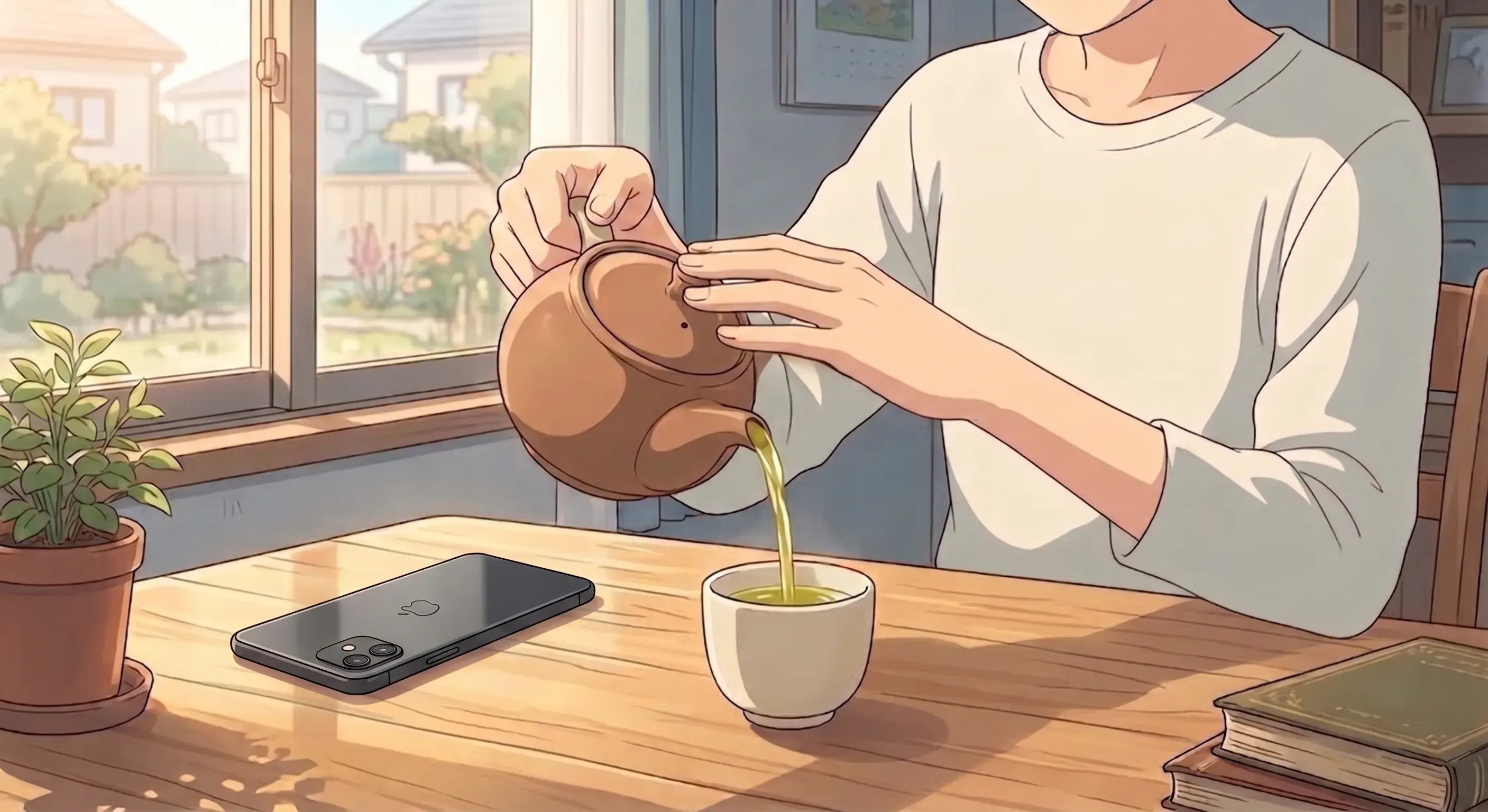
▲ A Generation Z morning ritual: phone face-down, tea steeping in the pot
Why Tea? — The Unchanged Choice of Those Who Seek Quiet
There is no primary source that proves tea caused the creativity at Rishikesh, or that macrobiotic tea caused the music at the Seed café. But tea appears repeatedly in the spaces these people inhabited: alternative cafés, Japanese-inspired food culture, and the ashram in Rishikesh. That frequency alone makes the connection worth examining.
Why tea? Not coffee, not alcohol. Why, again and again, tea?
Modern science offers one partial clue: L-theanine, an amino acid found in tea, may — several studies suggest — contribute to a state of calm alertness: focused, but without the stimulation caffeine alone tends to produce. They did not have the science to explain this at the time. Whether or not they consciously sensed a difference, tea offered a combination of caffeine and L-theanine that modern research has since begun to explore.
First, tea demands time. Brewing it well requires waiting: for the water to cool slightly, for the leaves to steep, for the liquid to settle. For people trying to resist the machine's speed, that enforced pause was itself a kind of resistance. You cannot rush a pot of tea without ruining it.
Second, tea is physical. To sit on the floor, as they did at Seed, and hold a bowl with both hands, feeling the warmth through the ceramic, brings the body into the ritual as well as the mind. Zen and Taoist thought had long insisted that truth is found in the simplest physical gestures of daily life. Brewing tea fit that idea precisely.
Third, tea enables conversation. Neither the Seed regulars nor the Rishikesh musicians drank alone. They passed cups around, talked, played, listened. Unlike alcohol, tea keeps the mind clear rather than loosening it — a social drink that allows conversation without demanding a performance.
Time, body, conversation. Those three qualities have not faded. Today, young people in cities across the West are turning to tea for reasons that go beyond a passing health trend — and perhaps for the same reasons as before. Choosing a drink that takes a few unhurried minutes to prepare is, in its own small way, a way of stepping outside the machine, if only for a moment.
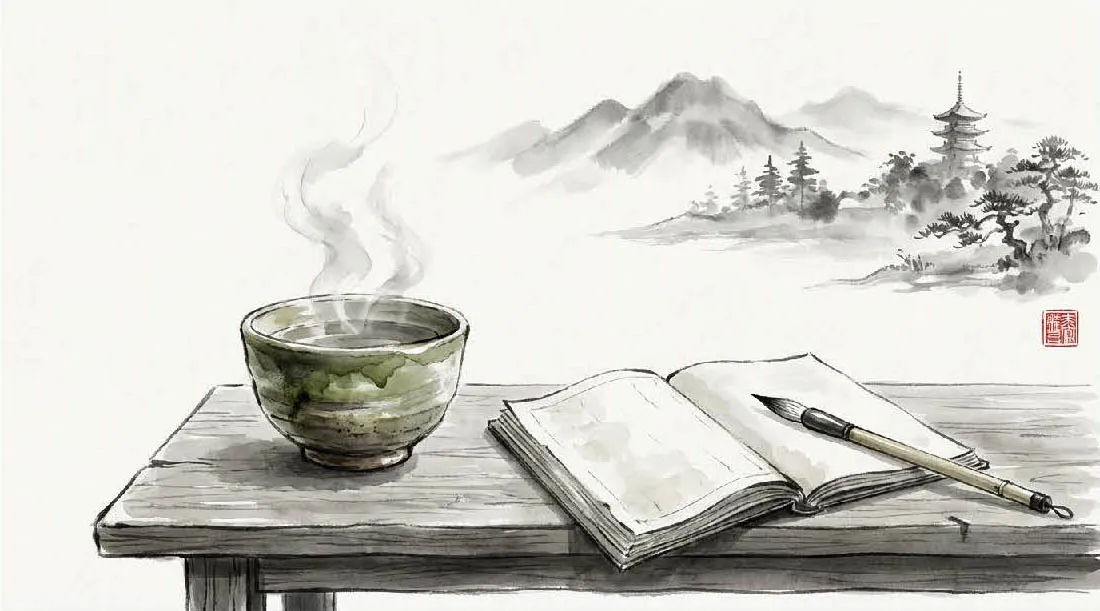
▲ A passport to your own silence — wherever the machine is loudest
The Passport to Quiet — Then and Now
The Beatles unplugging their guitars in the Himalayas. John Lennon and Marc Bolan sitting on the floor of a London restaurant around a cable-drum table, drinking unsweetened tea. A young person in New York or Berlin turning off their phone to brew a pot of tea in the early morning.
More than half a century separates these moments. The rituals look different. But in each of them, someone chose to slow down, to use their hands for something small and deliberate, to make a drink that required a little patience — and to share it.
In eighteenth-century Kyoto, a former Zen monk turned tea seller named Baisaou sold sencha from a portable stall on the city's streets, to anyone, regardless of rank, for whatever they could pay. He had walked away from an institutional career precisely because he believed tea should be open to everyone, free of hierarchy, and shared on equal terms. There is no historical line connecting Baisaou to the 1960s counterculture. But the attitude — step away from the machine, make tea, and talk to people as equals — feels remarkably similar across three centuries.
As long as society keeps driving us to be faster, more productive, and more efficient, we will need a way to unplug, briefly, regularly, without drama. Making tea and drinking it quietly is one of the oldest and most portable ways to do this. It costs little. It takes only a few minutes. It has been chosen, again and again, by people who needed to find themselves in the middle of the noise. That same passport is still available today, not in an ashram or a London café, but in your own kitchen.
🍵 Your own passport to quiet — from Minorien
The macrobiotic culture of the 1960s valued simple, unsweetened tea as part of a life lived more slowly and deliberately. That idea has not aged. Across generations, a carefully brewed cup of Japanese green tea remains one of the simplest ways to step outside the machine for a few minutes.
· Craig Sams and Gregory Sams: personal accounts (interviews and personal blog)
· The Beatles Bible and related Beatles historical resources
· Mario Savio, "Bodies Upon the Gears" speech, UC Berkeley, December 1964
· Nobre, A.C., Rao, A., & Owen, G.N. (2008), "L-theanine, a natural constituent in tea, and its effect on mental state," Asia Pacific Journal of Clinical Nutrition, and related peer-reviewed studies on L-theanine and cognitive state
· Research on Baisaou (Kōyūgai), eighteenth-century Zen monk and tea seller
Note: This article is based on historical sources and firsthand accounts, interpreted and contextualized by the Minorien editorial team. Some scene descriptions are illustrative rather than verbatim.
 Shop
Shop