Baisaou: The Zen Monk Who Left Temple Life to Sell Tea
Last updated: August 2026
- 1The Monk Who Left Temple LifeLife before the tea stall
- 2The Street Stall That Changed Tea CultureTsūsen-tei and the price of tea
- 3The Circle of Poets and PaintersJakuchū, Taiga, and Buson
- 4The Burning of the Tea UtensilsA final act of non-attachment
- 5The Man Who Wanted to Leave No TraceLegacy and bunjin sencha
The Monk Who Left Temple Life
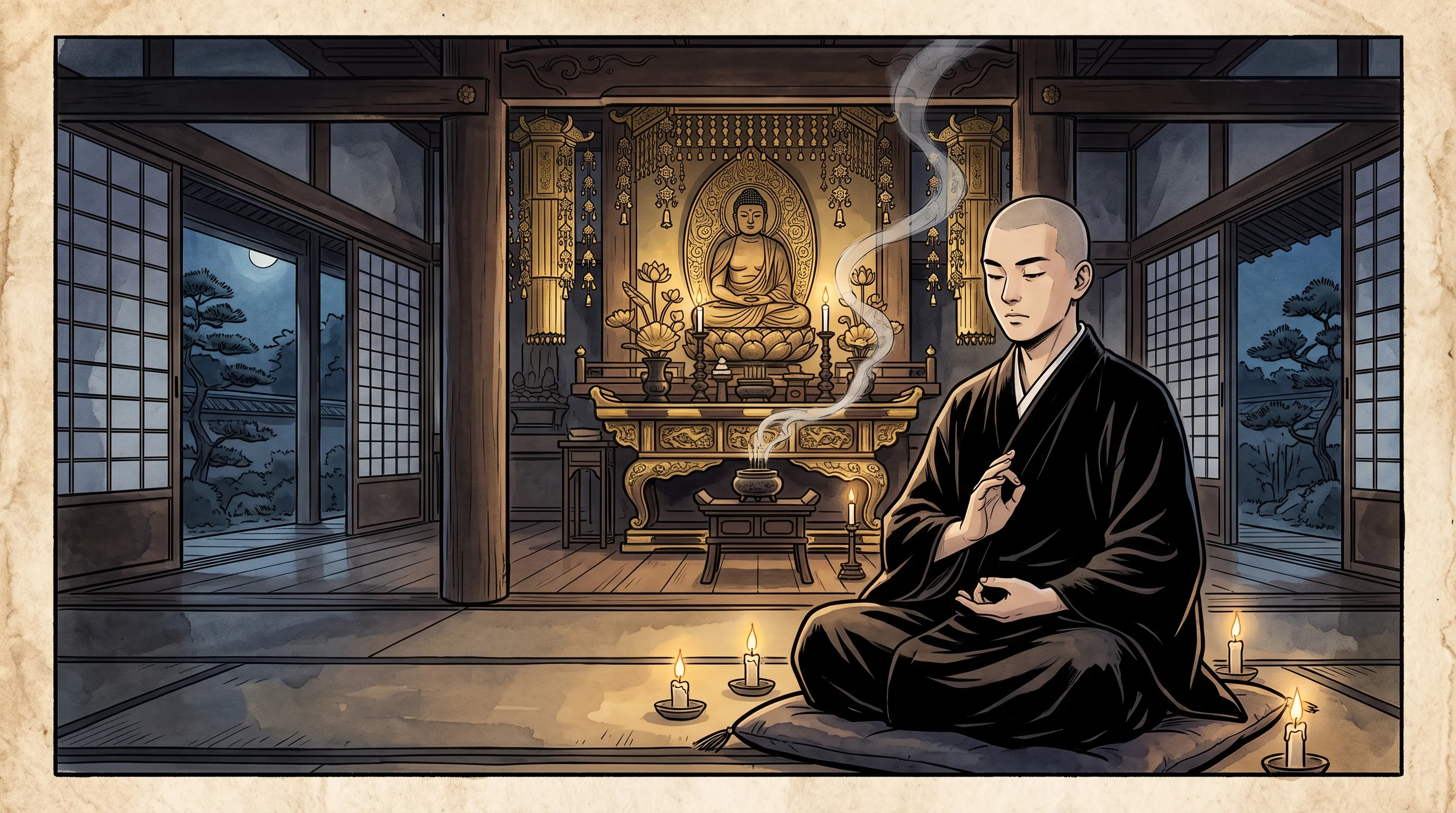
The young monk Gekkai devoted decades to rigorous training within the Ōbaku Zen school—mastering scriptures, enduring severe austerities, and serving his master for fourteen years.
Born in 1675 in Saga on the southern island of Kyushu, the man who would become Baisaou entered a Buddhist monastery at the age of eleven. He took the Dharma name Gekkai ("Moon Sea") and threw himself into the practice of Ōbaku Zen—a newly arrived Chinese tradition that sat at the intellectual forefront of Japanese Buddhism.
He was never content with a quiet monastic routine. At twenty-two, after falling gravely ill, he embarked on an arduous pilgrimage across northeastern Japan. He undertook rigorous fasting retreats in the mountains of Kyushu and studied under masters of multiple Buddhist traditions, seeking insights that extended beyond any single sect. For fourteen years, he served faithfully as steward at his home temple, Ryūtsu-ji—a position that could plausibly have led to becoming abbot, though no record confirms this was ever formally offered.
Instead, he stepped away. In his writings, he voiced disillusionment with monastic complacency and the reliance on lay charity, seeking a life unburdened by institutional politics. While later historians offer varied interpretations of his departure, his motives resist simple categorization. He simply left—and forged a path entirely his own.
- A senior post in a respected Zen monastery
- A position that could have led to becoming abbot
- Financial security and social standing
- The comfort and protection of monastic life
- A roaming tea stall on the streets of Kyoto
- A bamboo money tube with no fixed prices
- An honest, self-reliant livelihood
- A life built around his own sense of freedom
The Street Stall That Changed Japanese Tea Culture
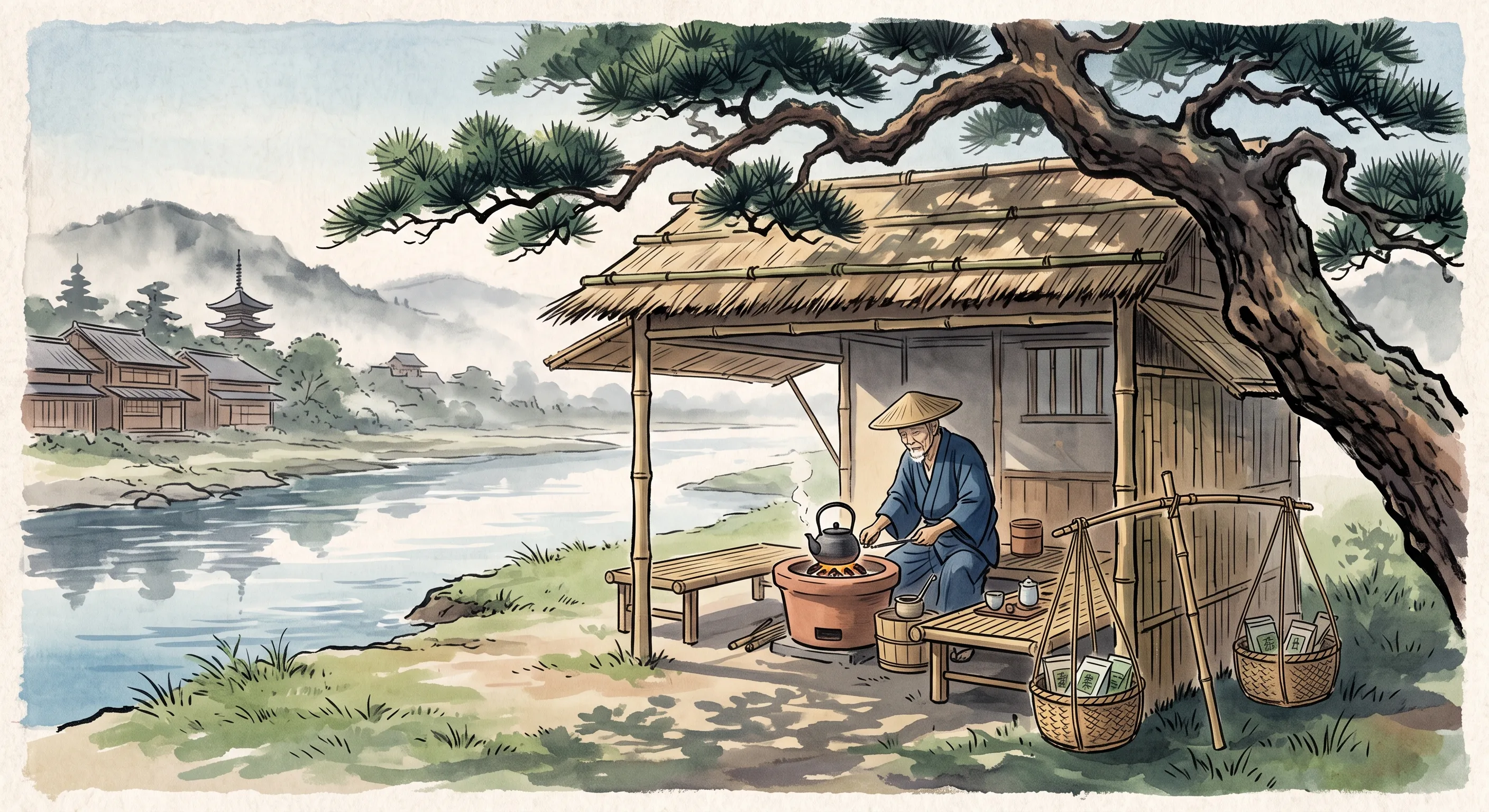
Baisaou set up his portable stall—which he named Tsūsen-tei, "The Pavilion Leading to the Immortals"—at scenic spots across Kyoto: along the Kamo River, among the hills of Higashiyama, and on the temple grounds of Tōfuku-ji.
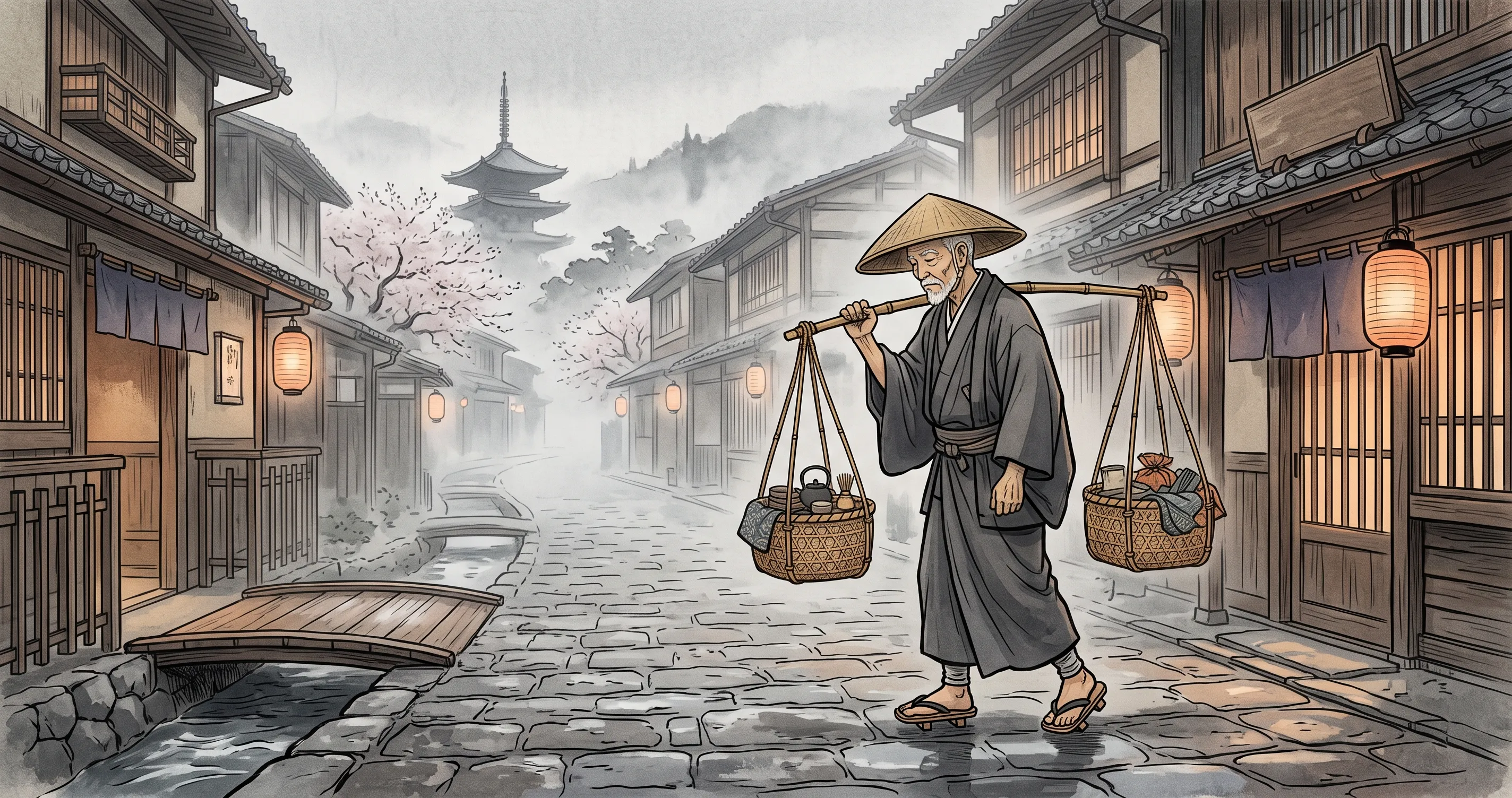
Around the age of sixty-one, Baisaou began carrying his tea gear through Kyoto on a shoulder pole. Suspended from either end were woven bamboo baskets containing a small brazier, a teapot, ceramic cups, and a supply of tea. He named this roaming stall Tsūsen-tei—"The Pavilion Leading to the Immortals"—and set it down wherever travelers paused: along the banks of the Kamo River, in the pine groves of Higashiyama, or beneath the autumn maples near Tōfuku-ji.
His approach contrasted sharply with the formal tea practices associated with elite circles. While elite tea practitioners competed over exorbitant antique utensils and rigid etiquette, Baisaou served his tea from simple, unpretentious wares. For payment, he set out a hollow bamboo tube, leaving the amount entirely to the customer's conscience. Contemporary accounts portray his stall as unusually open and informal for its time—the kind of place where people who might not otherwise have shared the same social space could sit and drink together.
He did not view this as a business. Tea was his vehicle for living Zen in the world. By selling tea on the open street, he immersed himself in everyday life, sustained himself through honest labor, and lived free of institutional reliance.
| Aspect | Baisaou's Approach |
|---|---|
| Location | Outdoors—riverbanks, temple grounds, and scenic viewpoints |
| Equipment | A modest clay brazier and simple teapot—no prized antiques |
| Tea | Steeped loose-leaf sencha, drawn from the Ōbaku tradition |
| Price | By most accounts, pay what you wish—or nothing at all |
| Clientele | Open to everyone, without distinction of rank or status |
The Circle of Poets and Painters
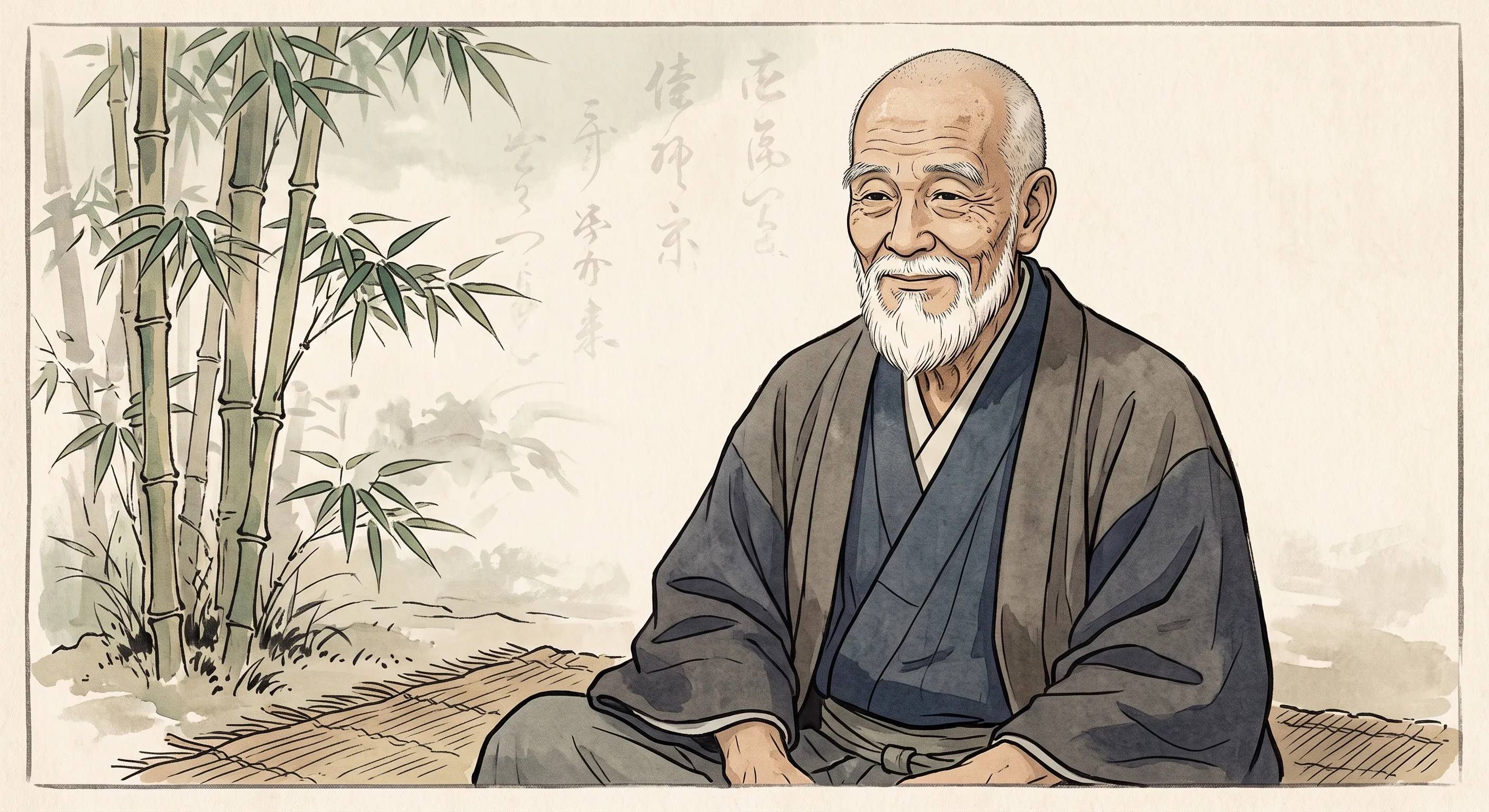
Illustrated portrait of Baisaou. The renowned painter Itō Jakuchū, one of the foremost artists of 18th-century Japan, painted his portrait multiple times. Baisaou's circle included many of the era's greatest cultural figures.
Baisaou was far more than an eccentric street vendor. He was a man of profound erudition—steeped in decades of Zen contemplation and classical Chinese literature—with an unmistakable presence that captivated the cultural elite of Kyoto. Word quickly spread, drawing leading artists, poets, and philosophers to his open-air stall.
His circle came to include some of the towering figures of eighteenth-century Japanese culture: the visionary painter Itō Jakuchū (who painted Baisaou's portrait multiple times), the literati master Ike no Taiga, the haikai poet Yosa Buson, and the novelist Ueda Akinari. For these creative minds, Baisaou offered an antidote to the rigid orthodoxy of the established tea ceremony: genuine conversation, freedom from social hierarchy, and an authentic encounter with the present moment.
In 1742, around the age of sixty-eight, Baisaou took the rare step of formally relinquishing his monastic vows (genzoku, or returning to lay life). He adopted the name Kōyūgai, drawn from the concept of xiaoyaoyou ("carefree wandering") in the Daoist classic Zhuangzi. Neither monk nor ordinary layman, he existed outside conventional social roles, entirely unattached to worldly prestige.
The Burning of the Tea Utensils
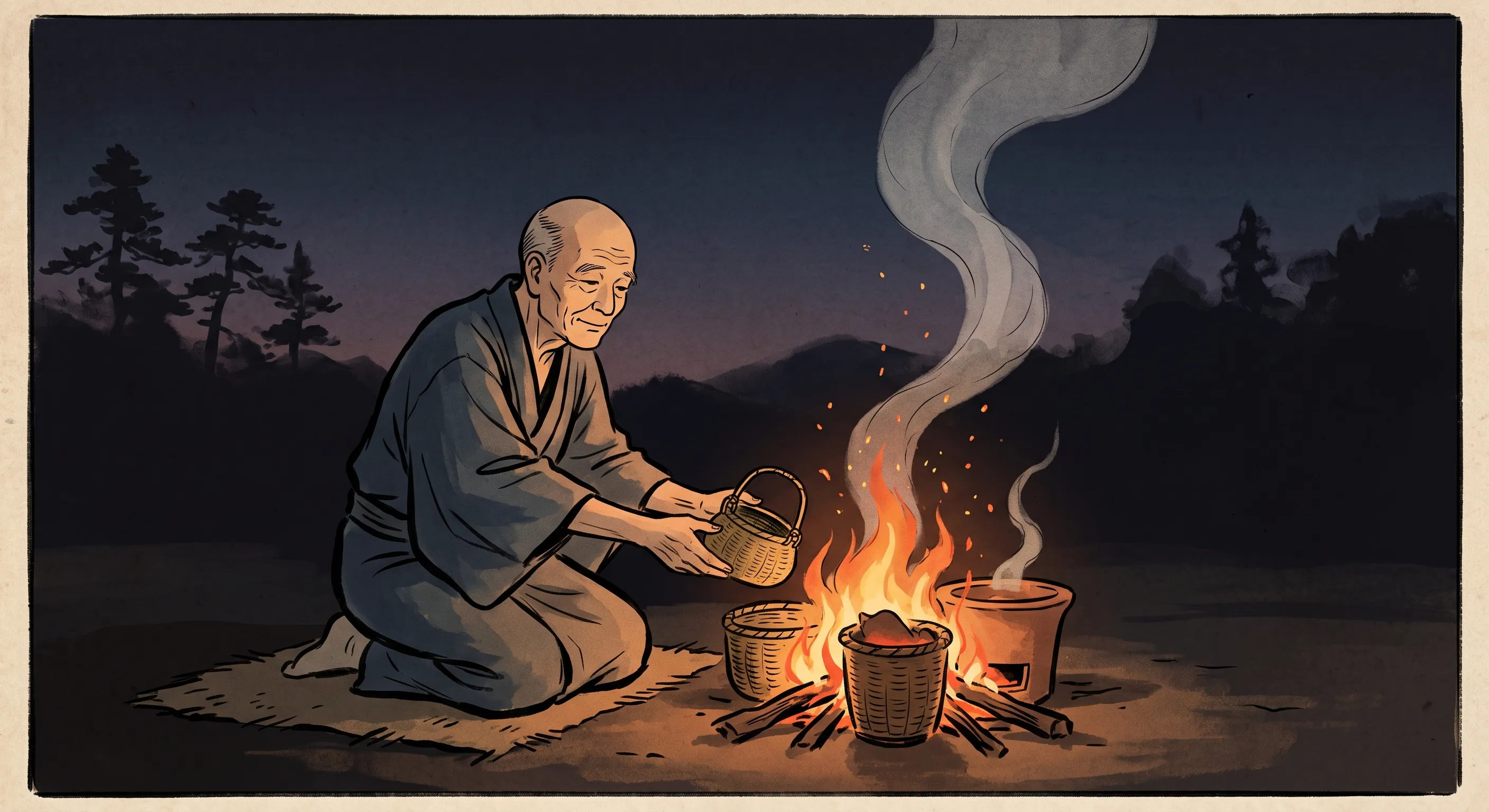
In 1755, at age eighty-one, Baisaou burned the tea utensils he had used for years. Later accounts describe the act as a final gesture of non-attachment.
In 1755, at the age of eighty-one, finding the physical toll of street vending too heavy to bear, Baisaou laid down his shoulder pole for good. He gathered his entire tea set—the brazier, teapot, cups, and carrying baskets—and consigned them all to the flames.
According to biographical accounts, he feared that after his death, people would trade his humble tools as collectors' items and status symbols, desecrating the spirit of simplicity they had embodied. Rather than allow his belongings to become commercial relics, he chose to return them to ashes. While historical records compiled decades later offer varying details, the burning of his utensils remains the defining gesture of his unyielding philosophy.
The gesture carries profound meaning. It was both a radical expression of non-attachment and a preemptive strike against institutionalization. Baisaou knew that revered objects often give birth to lineages, dogma, and exclusive schools—the very structures he had spent his life stepping away from.
The Man Who Wanted to Leave No Trace
- 1675 Born in Saga, Kyushu (given name: Shibayama Motoaki). Enters Ryūtsu-ji at age eleven and receives the Dharma name Gekkai.
- c. 1696 – Falls gravely ill at twenty-two; upon recovery, undertakes extensive pilgrimages across Japan and endures ascetic training at Mt. Raizan. Studies across diverse Buddhist traditions.
- – c. 1720 Gradually distances himself from temple administration, eventually departing the monastic establishment.
- c. 1736 Settles in Kyoto in his early sixties. Opens his roving tea stall, Tsūsen-tei, serving steeped sencha at scenic spots. Becomes widely known as Baisaou ("The Old Tea Seller").
- 1742 Formally renounces his monastic vows (genzoku) and adopts the name Kōyūgai. Deepens friendships with luminaries including Itō Jakuchū, Ike no Taiga, and Yosa Buson.
- 1755 At age eighty-one, burns his tea utensils and retires from selling tea.
- 1763 Passes away peacefully at eighty-nine. In accordance with his wishes, his remains are said to have been dispersed without a formal tomb.
Note: Since few firsthand records of Baisaou's life survive, some dates above are approximate and vary between sources.
Baisaou passed away in 1763 at the age of eighty-nine. He left behind no wife, no heirs, no grand tombstone, and no posthumous Buddhist title. According to tradition, his remains were dispersed near the Kamo River—the very waters beside which he had poured tea for decades—in accordance with his wishes. He sought to leave no footprint behind.
Later commentators often linked his life to the Zen ideal of motsushōseki (没蹤跡)—"leaving no trace." It signifies passing through the world with utter lightness: free from the accumulation of possessions, reputation, or institutional legacy.
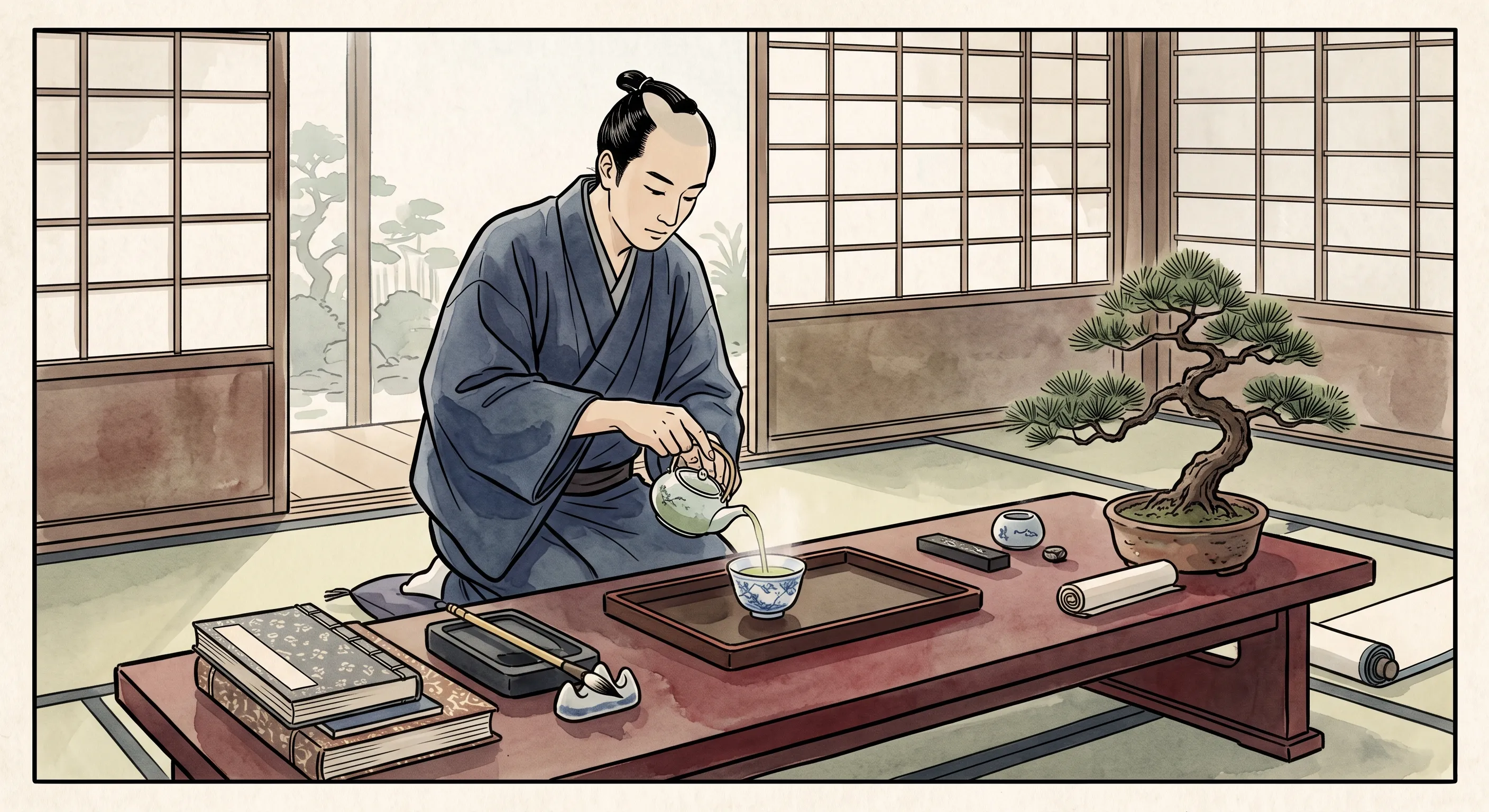
The tradition of bunjin sencha (literati tea) inspired by Baisaou became a vital current of Japanese tea culture, practiced by artists and intellectuals as an unpretentious alternative to the formality of chanoyu.
With fitting irony, the man who refused to build a legacy shaped one of the most vibrant traditions in Japanese tea history. His example became one of the most important inspirations behind the later development of bunjin sencha (literati tea)—an aesthetic embraced by artists and scholars as an authentic, intellectual alternative to the rigid formalities of the traditional tea ceremony (chanoyu).
Today, at Manpuku-ji in Uji, a memorial hall called the Baisa-dō enshrines a wooden statue of the master. His name and spirit endure across Japan, quietly celebrated wherever tea is enjoyed with simplicity and sincerity.
Why Baisaou Still Matters
The story of Baisaou is far more than a historical curiosity. It offers a rare and vivid example of a life lived strictly on one's own terms, untethered from social expectations and institutional demands.
He harbored no hostility toward Buddhism or the art of tea; indeed, he dedicated his life to both. What he rejected was the way sacred and meaningful traditions are so easily reduced to displays of wealth, status, and social pretense. When he burned his teaware, later tradition remembers it as a way of protecting the purity of his craft from becoming just another commodity.
The distinction between doing something out of pure devotion and doing it for outward validation remains as vital today as it was in the eighteenth century. On the streets and riverbanks of Kyoto, Baisaou is remembered for showing that a simple cup of tea, offered freely and without pretense, could hold something of the essence of Zen.
Taste a Little of Baisaou's World
His stall offered nothing more than loose-leaf sencha, hot water, and a moment of unhurried conversation. That's still all it takes.
· Baisaou-den (1814), the primary early biography of Baisaou, compiled decades after his death
· Research on Baisaou (Kōyūgai) and the Ōbaku Zen tea tradition
· Studies of Itō Jakuchū's relationship with Baisaou and his circle of Kyoto literati
· Records associated with Manpuku-ji, Uji, and the Ōbaku school
Note: This article is based on historical research, interpreted and contextualized by the Minorien editorial team. As with many figures from this period, factual record and transmitted legend overlap; some scene descriptions are illustrative rather than verbatim.
 Shop
Shop