The True Nature of Wabi-Sabi ── What Sen no Rikyu Can Teach Us About Loving Imperfection
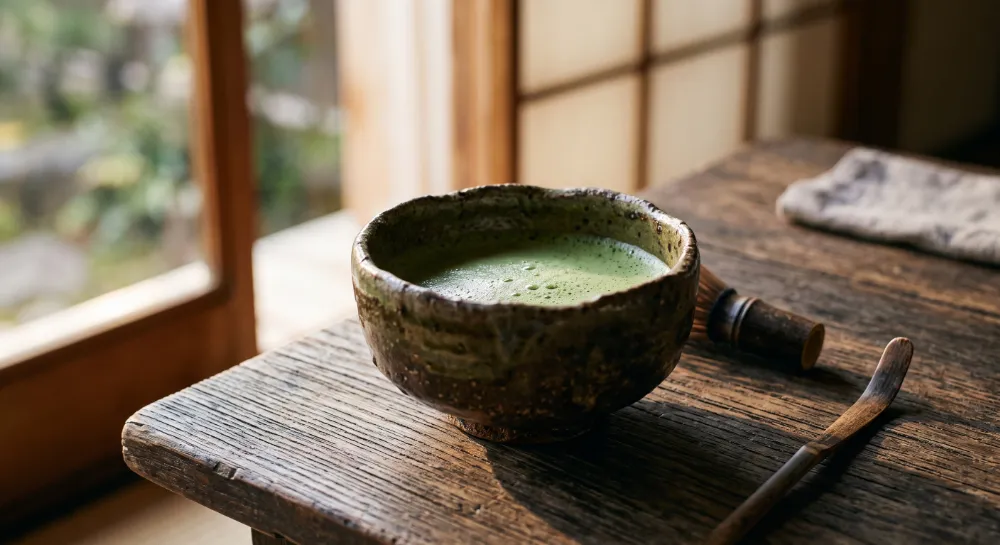
Online, "wabi-sabi" has quietly become a term of endearment. A crooked nose, a dog's permanently mussed-up fur, a partner's small clumsy habit — all get tagged, half-jokingly, half-sincerely, as "wabi-sabi." In a culture that pushes flawless images at every turn, claiming your own imperfections as "wabi-sabi" has become a small act of self-love. It's a warm way to use the word, and a real one: this reading does capture one genuine facet of what wabi-sabi means. What it doesn't quite capture is the fuller story — the one that was shaped, centuries ago, inside the tea ceremony of Japan.
"Wabi-sabi" is actually two older words fused into one. "Wabi" is the sensibility that finds richness and quiet in simplicity — even in what looks unfinished or plain. "Sabi" is the sensibility that finds beauty in the marks time leaves behind. Both ideas developed over centuries, shaped by Zen thought and generations of poets and tea masters before him — but it was Sen no Rikyu, in the sixteenth century, who gave them their most lasting form inside the tea ceremony. Here is how.
Where "Wabi" Ends and Neglect Begins — A Single Flaw in Perfect Order
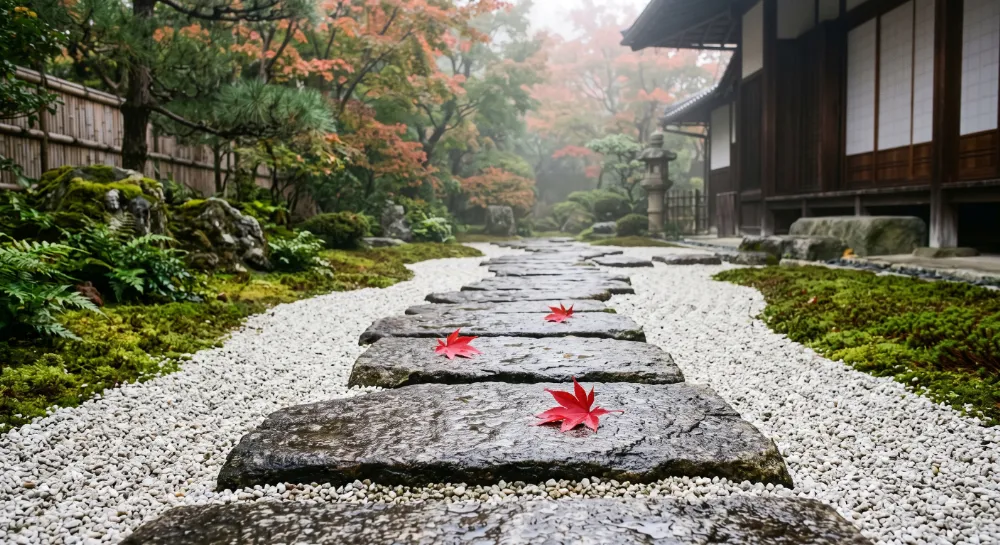
A few maple leaves, resting quietly on a freshly swept stone path.
Some interior design blogs will tell you that a messy room or a piece of furniture left broken counts as "wabi-sabi style." But "wabi" — in its original sense — is close to the opposite of neglect.
One story about the tea master Sen no Rikyu illustrates that difference better than any definition could.
Among the many stories told about Rikyu, this is one of the most enduring. One day, Rikyu asked a student to sweep the garden path leading to the tea room. The student swept every fallen leaf away and reported, proudly, that there was nothing left to clean. Rikyu told him it lacked taste — and reached up to shake a tree branch, letting a few beautiful maple leaves fall onto the stones he had just had swept clean.
First, a perfect, spotless order. Then, deliberately, the smallest trace of nature's own disorder let back in. This sense — order built up carefully, then allowed one small, intentional ripple — is often described as the heart of "wabi" in the tea ceremony.
But this isn't simply about adding a little mess for effect. The point isn't the leaves themselves — it's the tension between what a person's hands carefully arrange, and what they ultimately choose to leave alone.
Beyond Cold Minimalism — Where "Sabi" Lives, In the Slow Turn From Wear to Character
A second common misreading shows up whenever you search "wabi-sabi style" online: bare concrete walls, dusty earth-toned furniture, a cold and minimal room. That's a surface-level mix-up of Western "minimalism" with "wabi-sabi" — two different ideas that happen to share a muted color palette.
- A system built to deliver the same quality, every time
- A preference for uniform color and shape
- High reproducibility
- A flavor that never changes
- The individual character that nature and handwork leave behind
- A flavor shaped by season and origin
- Character that deepens with use
- A cup that's a little different every time you meet it
None of this is a knock on consistency itself. Every year, Japanese tea blenders taste and balance leaves whose flavor shifts with the season and the weather, working to hand customers a cup that tastes reliably like itself — a skilled craft in its own right, called gōgumi. What wabi-sabi pays attention to is something else: not the smoothing-over of that natural variation, but what shows through when it's allowed to remain visible.
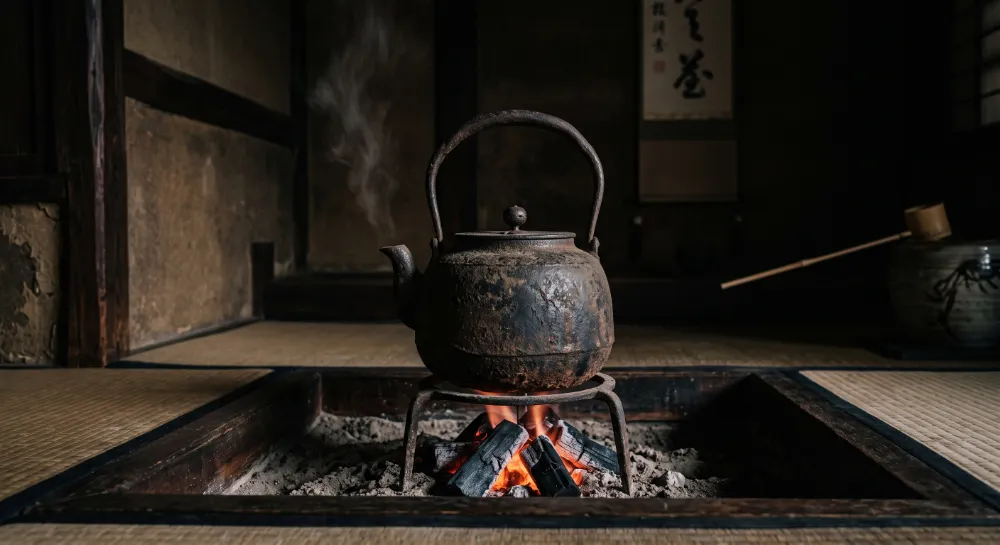
An iron kettle, worn to a beautiful patina after years of use.
In English, "patina" comes close to one part of "sabi," but it doesn't cover the whole idea — sabi also carries a quieter sense of solitude and stillness that patina alone doesn't quite reach. Still, patina is a good place to start. "Sabi" is not simply a word for old or worn out. It describes the change that time brings to an object's color and texture, and the fondness with which that change can be viewed. The walls of Taian — a two-tatami-mat tea room said to have been built by Rikyu, and among the very few tea rooms still standing that historians consider credibly linked to him — are rough clay mixed with straw. Over time, that wall will crack. An iron kettle that rusts a little more with every use isn't losing value through "decay" — it's been treated, for centuries, as a living object that grows more "mature" the longer it's cared for. It's the care and attachment a person brings to an object that turns ordinary wear into "sabi."
This isn't only a story about old tea rooms. We hear it in our own shop, too. Many customers, when the inside of a teapot starts to darken with a thin layer of tea residue, assume it's grime, and scrub it off with bleach until the clay is white again. But that thin film is really a record of the tea the pot has poured over the years. It isn't the same thing, chemically, as rust on an iron kettle — but both are, in their own way, a kind of character that only comes from being used again and again.
The Beauty of Asymmetry — Finding "Wabi" in Every Crack and Curve
If "sabi," as we saw in Chapter 2, is something time produces, the asymmetry we're about to look at is the product of the other sensibility — "wabi." Finding richness in simplicity and imperfection turns out to show up in the very shape of an object, not only in the marks time leaves on it.
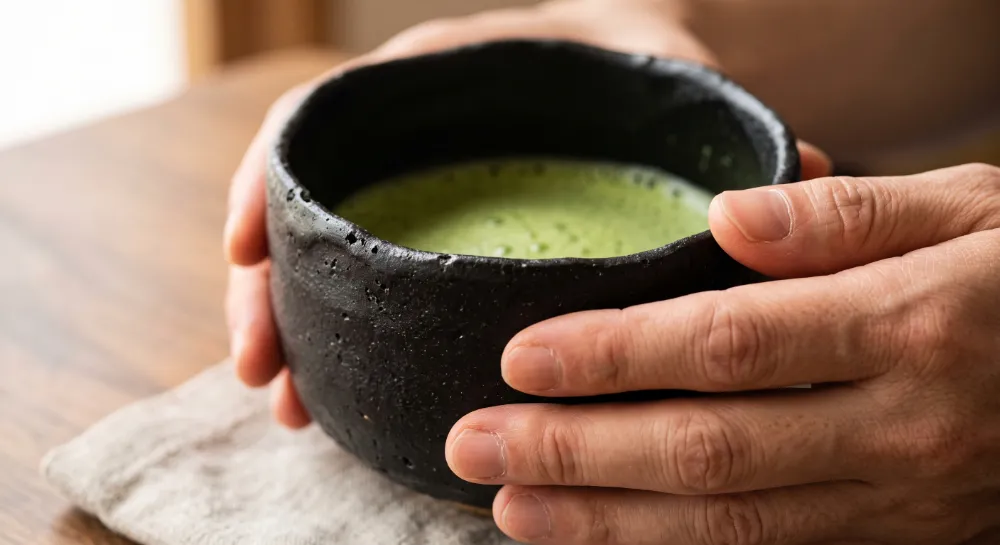
A pair of hands, warmly cupping an uneven, black raku tea bowl.
Japanese tea culture never treated perfect symmetry as the only standard of beauty; it also found charm in asymmetry and imbalance. Before Rikyu's time, the most prized tea utensils in Japan were "karamono" — wares imported from China, prized for their flawless, symmetrical form. Rikyu, by contrast, is said to have found new value in "raku" tea bowls (specifically black raku), hand-built without a potter's wheel. That hand-building naturally produces small, irregular warps and asymmetries.
But the human hand, too, is asymmetrical and imperfect. Maybe that's exactly why cupping a slightly warped raku bowl in both hands feels warmer than holding a flawless, mass-produced one — a warmth particular to something made by hand.
The same spirit runs through "kintsugi" — the practice of rejoining a broken vessel with lacquer and gold, and leaving that seam visible rather than hidden. Kintsugi and wabi-sabi are often mentioned in the same breath online, but they aren't quite the same thing: kintsugi is one specific repair technique, while wabi-sabi is the much broader way of seeing that makes a repair like that feel meaningful in the first place. In some cases, the mended line itself becomes something worth looking at in its own right. That said, this isn't the same as simply declaring that "flaws are beautiful." It's closer to accepting an object whole — the time it has accumulated, and even the trace of the hands that chose to keep repairing and using it, rather than replacing it. That shift in perspective may be exactly what people exhausted by the pressure of perfectionism are sensing, intuitively, in the word "wabi-sabi" today.
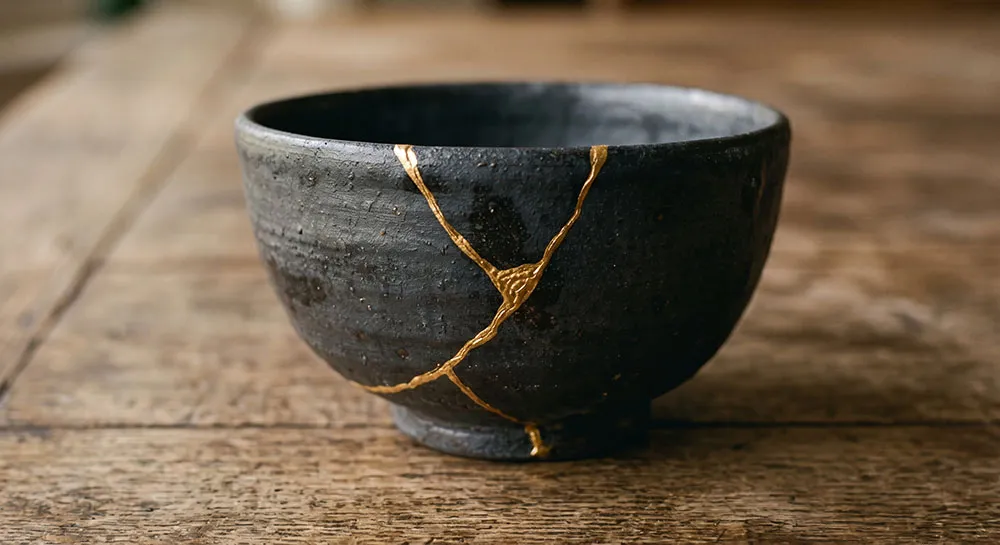
A crack left visible, rejoined with a thin line of gold.
A related, older story is often cited as a forerunner of this sensibility. A celadon tea bowl now called Bakōhan, held today in the Tokyo National Museum, is said to have belonged to the shogun Ashikaga Yoshimasa in the 15th century. When it cracked, it was sent back to China for a replacement — but no equal could be made, so it was returned mended with metal staples instead, resembling the legs of a locust (a "bakō"). The staples, rather than being seen as a flaw, only raised the bowl's reputation. It's worth noting this repair used metal, not the lacquer-and-gold technique of kintsugi proper, and the story itself wasn't written down until some three hundred years after Yoshimasa's time — so its details, like Rikyu's garden, are best read as legend rather than settled fact. Still, it points to something that ran through Japanese taste well before kintsugi had a name: a repaired object could be worth more, not less, for showing its repair.
In Closing — Just Boil Water, Whisk the Tea, and Drink It
Among the sayings passed down as Rikyu's teaching, collected long after his death in a set of verses known as the Rikyu Dōka, is this one: "Know that the Way of Tea is nothing more than this: boil water, make the tea, and drink it."
Wabi-sabi was never meant to be a difficult subject for admiring expensive antiques in a museum case, and it isn't a design trend to compete over online. Whatever's already at hand is enough. We try to hold onto that at our own shop, too: just boil water quietly for yourself, whisk the tea, and taste it while you feel its warmth in both hands. Care gently for an imperfect self, and live the day with a little more attention.
Is there a slightly chipped cup, or a teapot gone a little darker with age, sitting at the back of a cupboard somewhere in your own kitchen? Maybe it's not quite worn out enough to replace, and not quite in rotation either — just sitting there, half-forgotten.
Put the phone face-down for a few minutes, and make tea in that cup. Taste an imperfect bowl of tea, quietly, just as it is. In that simple act may live a small piece of what "wabi-sabi" still has to offer us today — and it's the piece we come back to, every time we put the kettle on.
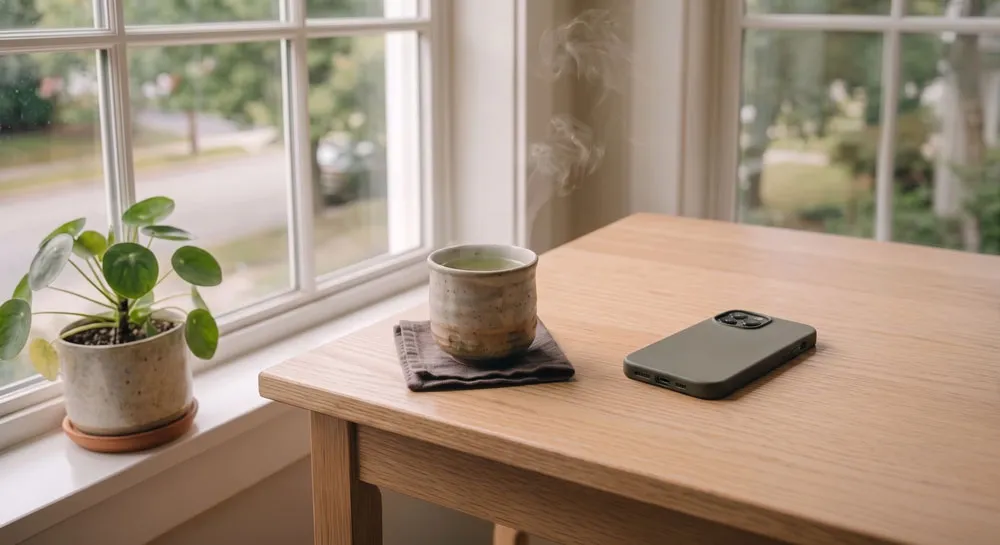
A phone turned face-down beside a cup of sencha, poured into a well-worn yunomi.
Experience It With Tea
Wabi-sabi is easier to feel than to explain, in our experience. Choose a cup you already own, brew a pot slowly, and notice what changes when you stop looking for perfection.
 Shop
Shop