How Tea Transformed Edo
Last updated: August 2026
- 1Tōcha: A High-Stakes Gambling GameMedieval tea dueling and its stakes
- 2The Invention of Modern SenchaNagatani Sōen's breakthrough
- 3Baisaou and the Democratization of TeaTea for everyone, on the streets
- 4Mizu-jaya: Edo's Tea StallsThe city's social hubs
- 5Botefuri: The Roaming Tea MerchantsTea delivered door to door
Tōcha: When Tea Was a High-Stakes Gambling Game
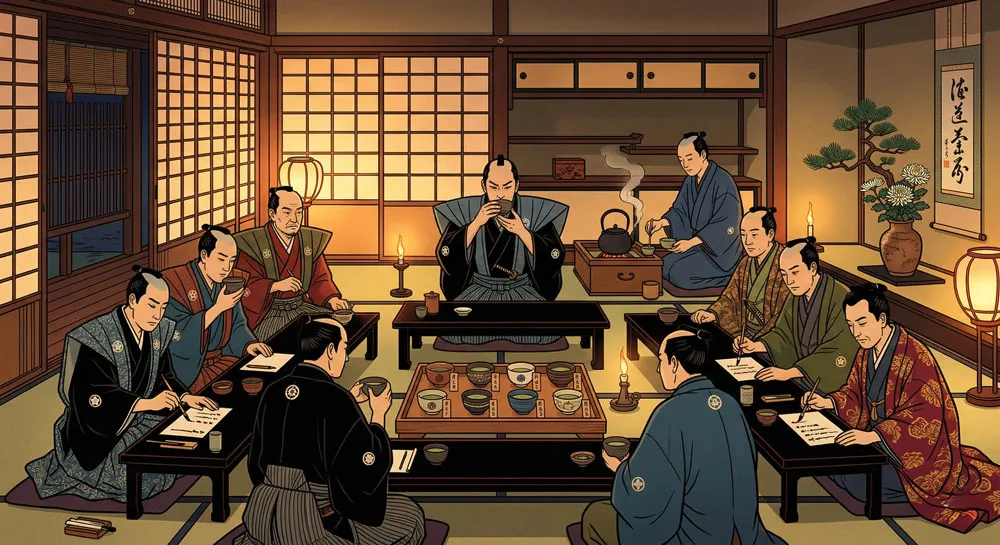
A tōcha gathering during the Muromachi period.
Before Edo, tea had already reshaped Japan once. That earlier chapter, playing out in the Kamakura and Muromachi periods, is where the story of Edo's tea culture actually begins.
Today, green tea is celebrated worldwide as a symbol of tranquility, mindfulness, and quiet contemplation. Yet it was not always so serene. Centuries ago, tea was at the center of frenzied social rivalries and reckless wagers.
Toward the end of the Kamakura period, a competitive tasting game known as tōcha ("tea dueling") was introduced from Song-dynasty China. The premise was deceptively simple: participants tasted a series of cups blind and attempted to distinguish genuine, prized teas from inferior varieties. Guess correctly, and you walked away with lavish prizes; guess poorly, and you forfeited your stake. While it might sound akin to a modern sommelier's blind tasting, the medieval version was far from genteel.
By the Muromachi period, tōcha had swept through the samurai class and affluent merchant circles, with stakes escalating dramatically. Historical chronicles recount fortunes in gold, silver, fine silk, landed estates, and even treasured family swords changing hands over single tasting matches. What began as an exercise in distinguishing genuine Toganoo tea (honcha) from all other regional teas (hicha) evolved into grand spectacles known as chayoriai. These opulent, all-night gatherings merged competitive tea contests with lavish banquets featuring incense appreciation, linked-verse poetry, and endless rounds of sake.
The ruling authorities took swift notice. Alarmed by the social disruption, the Ashikaga shogunate issued repeated edicts banning tōcha alongside other forms of extravagant gambling. The very fact that these prohibitions had to be reissued time and again reveals just how intoxicating the craze had become.
By the peaceful Edo period, the wild mania of tōcha had subsided, but its legacy quietly endured. The refined discernment of tea origins and leaf qualities survived in the aesthetic traditions of tea connoisseurship, and something of that same spirit of careful discrimination can still be recognized in modern tea-tasting competitions and professional evaluation certifications.
▶ Read more about the rules and mania of tōcha
A Quiet Revolution: The Invention of Sencha
In 1853, Commodore Perry's "Black Ships" arrived off the coast of Uraga, sending shockwaves across feudal Japan. Yet more than a century before that political upheaval, a quieter and far more intimate revolution had already transformed daily life throughout the realm: the birth of modern sencha.
That revolution unfolded against a broader backdrop. In the late sixteenth century, Sen no Rikyū codified wabi-cha, elevating the tea ceremony into a rigorous spiritual discipline. Following Rikyū's death, his disciple Furuta Oribe challenged this austerity with unconventional pottery and expressive forms (Oribe-gonomi). Yet the tea ceremony remained the exclusive domain of samurai lords and elite patrons, out of reach for ordinary people.
The green tea we enjoy today—steeping whole dried leaves in hot water inside a teapot—was perfected in 1738 by Nagatani Sōen, an innovative tea farmer from Uji-Tawara, near Kyoto.
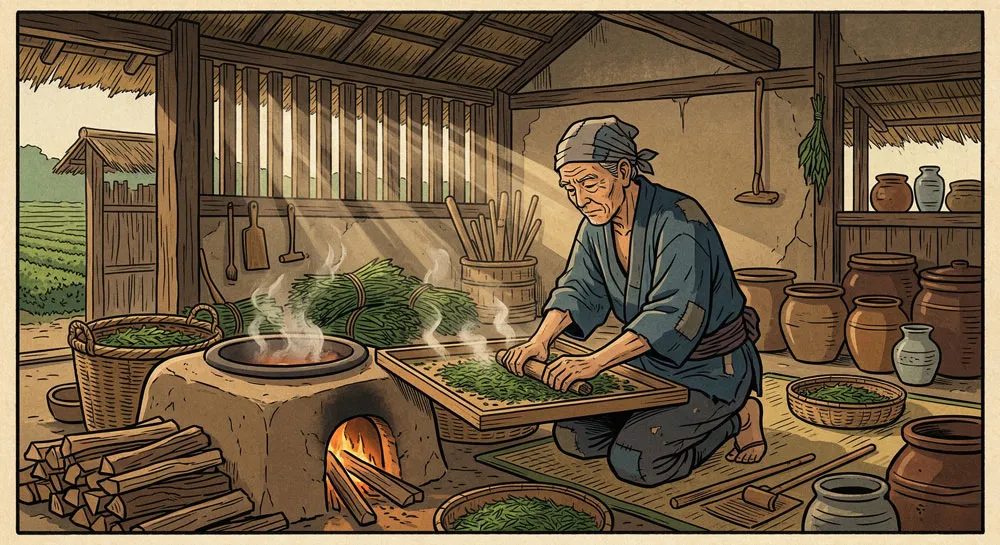
The green-steamed sencha method (aosei-sencha seiho) developed by Nagatani Sōen.
Before Sōen's breakthrough, Japanese tea culture looked vastly different. Whisked matcha reigned supreme in aristocratic halls and the solemn rituals of the tea ceremony, remaining largely inaccessible to commoners. Ordinary townspeople and farmers drank coarse bancha or sun-dried leaves boiled in water—a murky, brownish infusion that shared little with the vibrant green tea we know today. Sōen developed the aosei-sencha seiho method: immediately steaming fresh tea leaves to halt oxidation, then hand-rolling and drying them over a heated hearth. This revolutionary technique preserved the leaves' vivid emerald color, delicate sweetness, and refreshing aroma for the very first time.
Sōen traveled to Edo and presented his creation to the prominent tea merchant Yamamoto Kahei (founder of the historic Yamamotoyama brand). The tea created an immediate sensation. Accustomed to dull brown infusions, the residents of Edo were astonished by its luminous green hue and crisp fragrance. Sencha swept through the shogun's capital, embraced across all levels of society—from scholars and poets to merchants and artisans.
▶ That same sencha, carried forward nearly 300 years, is ready for your own cup (Japanese)
Without Sōen's manufacturing breakthrough, Japanese sencha culture as we know it today would look very different. Nagatani Sōen remains one of the most influential figures in Japanese tea history—and, as a small footnote, his descendants would later found Nagatanien, the food company still known today for its ochazuke seasonings.
Sōen's sencha offered a third path: neither the rigid formalism of ceremonial matcha nor the rustic roughness of boiled bancha, but a refined, accessible brew for everyone.
Baisaou: Taking Tea to the Streets
Around the same time Nagatani Sōen was refining his sencha method, an extraordinary figure appeared in Kyoto. Carrying portable tea gear suspended from a bamboo shoulder pole, he wandered the city, setting up an open-air stall wherever the view was fine and pouring tea for anyone who passed by. He was Baisaou ("The Old Tea Seller"), born Shibayama Motoaki (1675–1763), a former Zen monk from Hizen Province (modern-day Saga Prefecture).
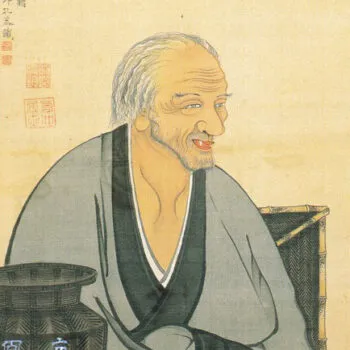
Illustrated portrait of Baisaou. He maintained close friendships with leading painters of his era, including Itō Jakuchū and Ike no Taiga, who painted his portrait on numerous occasions.
In Baisaou's era, Japanese tea was split between two extremes: the strict, ritualized tea ceremony reserved for the ruling class, and the crude, bitter bancha consumed by commoners. Baisaou rejected both worlds.
Setting down his portable stall, named Tsūsen-tei ("The Pavilion Leading to the Immortals"), on riverbanks and temple grounds, he invited all passersby to sit and drink. There were no tatami mats, no hierarchy, and no set fee—only a bamboo tube where guests left whatever they wished. Samurai, merchants, and farmers sat side by side as equals.
Instead of whisking powdered matcha, Baisaou steeped loose-leaf green tea in small pots, drawing on the Ōbaku Zen tradition. This simple, ceremony-free way of drinking resonated with Nagatani Sōen's simultaneous manufacturing revolution in Uji, together laying the foundation for a democratic, everyday tea culture in Japan.
At age eighty-one, Baisaou burned his beloved tea utensils to prevent them from becoming expensive collectors' items or tools of formal schools after his death. His fierce independence and spiritual clarity deeply inspired Kyoto's cultural elite, including painters Itō Jakuchū and Ike no Taiga, poet Yosa Buson, and author Ueda Akinari.
Baisaou's spirit laid the groundwork for sencha-dō (the literati way of steeped tea)—a practice that privileged spontaneous conversation over formal silence, and personal freedom over prescribed ritual. That same spirit of everyday conviviality soon blossomed across the capital in the bustling world of urban tea stalls.
▶ Read more about the life of Baisaou
Edo's Cafés: The World of the Mizu-jaya
As steeped sencha grew popular throughout Edo, vibrant new gathering places emerged along the capital's busiest thoroughfares: the mizu-jaya (roadside tea stalls).
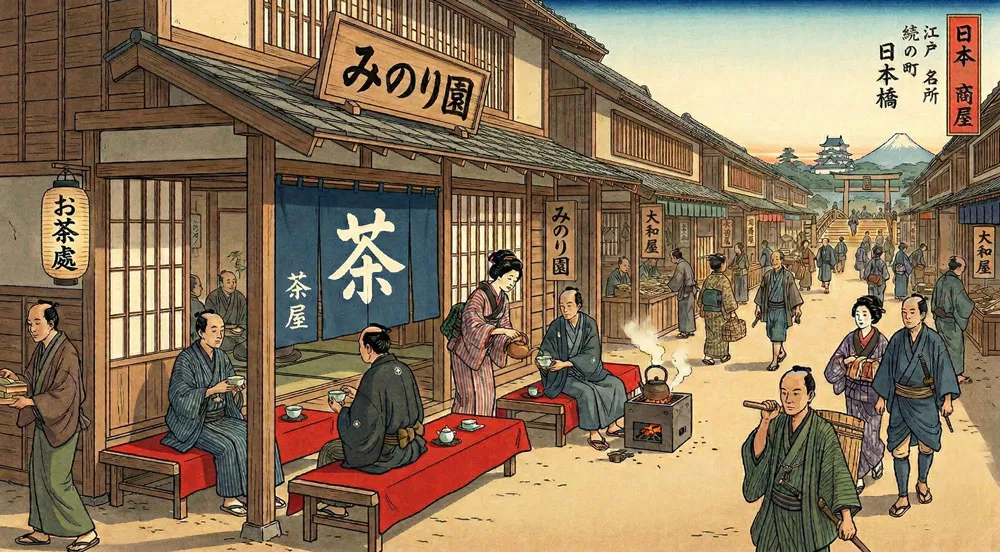
Set up near temple gates, busy bridges, and river crossings, a mizu-jaya was an open-air oasis for urban life. For the modest cost of a single coin, a visitor could sit on a red-cloth bench, enjoy a freshly brewed bowl of green tea, and savor a skewer of grilled dango (rice dumplings). Weary travelers rested their feet, neighbors exchanged neighborhood news, and merchants finalized trade deals. In many respects, a mizu-jaya served a role not unlike the modern café: a place to rest, refresh, and be seen.
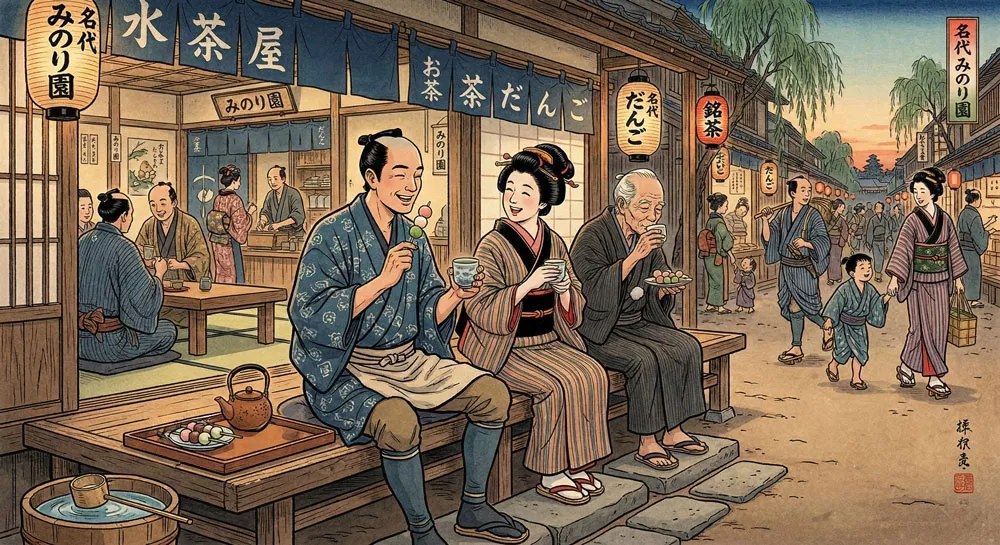
Townspeople relaxing on shaded benches with tea and dango at a bustling mizu-jaya.
By the late eighteenth century, hundreds of mizu-jaya operated across Edo. Areas like Asakusa Sensō-ji, Ueno Kan'ei-ji, and the foot of Ryōgoku Bridge became fiercely competitive hubs, teeming with pilgrims, theatergoers, and travelers.
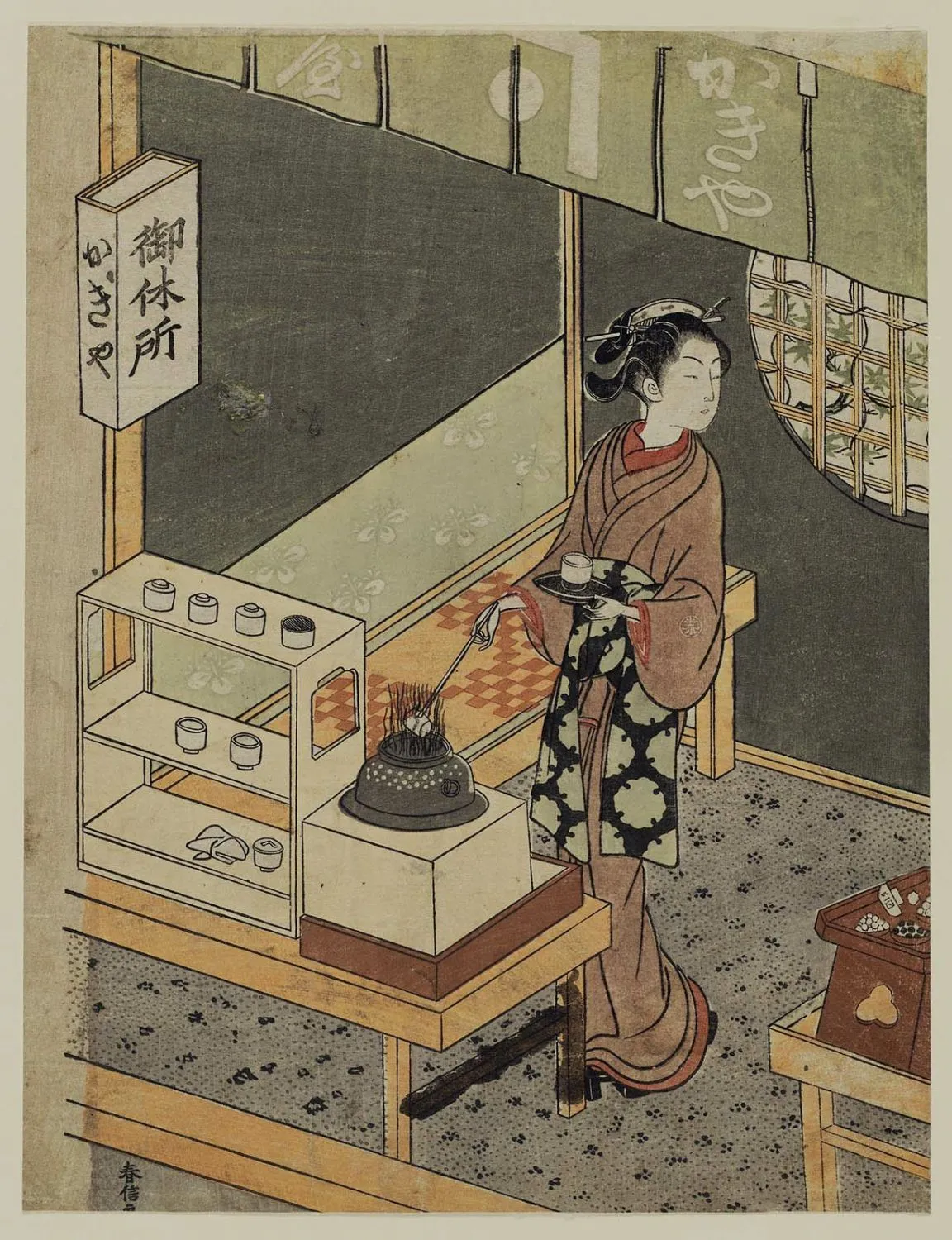
Illustrated depiction of Kasamori Osen, immortalized in ukiyo-e woodblock prints by Suzuki Harunobu. Serving at the tea stall Kagiya near Kasamori Inari shrine, she was one of Edo's most celebrated figures.
Central to the appeal of many popular stalls was the kanban musume—the charming "signboard girl" whose presence drew patrons from across the city. Renowned ukiyo-e masters like Suzuki Harunobu, Katsushika Hokusai, and Kitagawa Utamaro frequently depicted these tea stall beauties, creating some of the most iconic prints of the floating world.
The most famous of all was Kasamori Osen, who served tea at the Kagiya stall in Yanaka. Her grace inspired poems, woodblock prints, and popular songs, transforming her into a citywide celebrity—a cultural phenomenon remarkably reminiscent of a modern viral sensation.
More than simple refreshment stands, mizu-jaya served as the information arteries of the metropolis. Haiku poets gathered there to compose verses, playwrights eavesdropped for dialogue, and merchants tracked shifting market prices. They were the bustling social hubs that fueled Edo's creative vitality.
Just as we gather in modern coffee shops to converse, work, or meet colleagues today, the residents of Edo gathered over a cup of green tea on a wooden bench. While three centuries have passed, tea's power to create community remains completely unchanged.
The Roaming Tea Merchants: The World of the Botefuri
While mizu-jaya were the fixed social hubs of the city, tea was also carried directly to doorsteps by botefuri—the tireless traveling peddlers who navigated Edo's dense residential quarters.
Carrying wooden boxes and woven baskets balanced on long shoulder poles, botefuri supplied the daily necessities of urban life, from fresh fish and tofu to seasonal vegetables. Tea merchants were among the most welcome fixtures in the alleys.
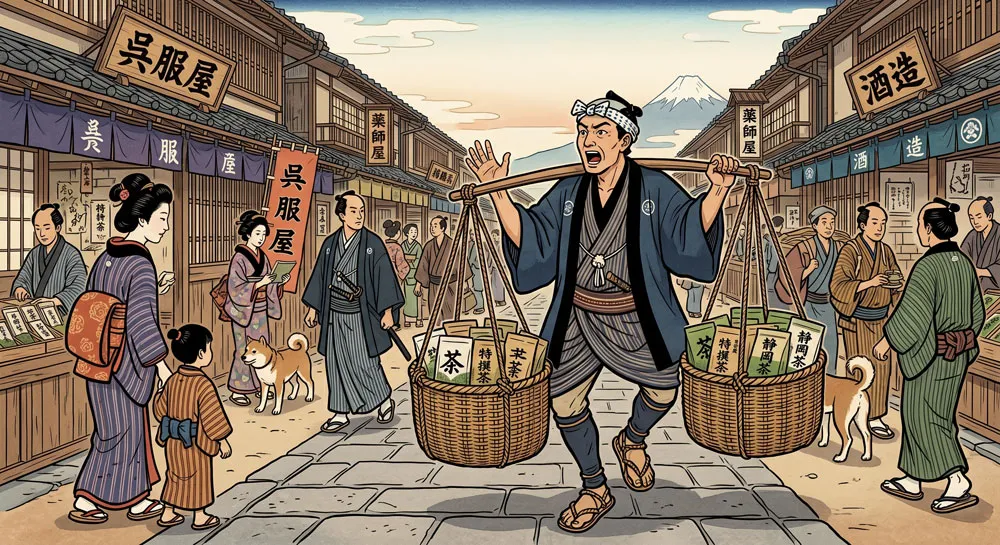
An Edo-period botefuri balancing his tea wares on a shoulder pole.
"O-cha wa ikaga de—" ("Would you care for some fine tea?") Their familiar melodic street calls signaled the arrival of the merchant. Because botefuri sold freshly weighed leaves in small, affordable quantities, everyday households could regularly purchase high-grade sencha without keeping large, costly inventories at home.
Their business practices were remarkably sophisticated. Botefuri remembered each household's preferred roast, brought "the regular blend" automatically, notified connoisseurs when the fresh spring harvest (shincha) arrived, and offered small seasonal courtesies to loyal patrons—an early predecessor of personalized customer care.
Over time, successful botefuri established permanent street stalls, which grew into neighborhood storefronts and wholesale merchant houses. The technology has changed since then—from shoulder poles to mail-order catalogs to online stores—but the basic relationship between tea merchant and tea drinker has stayed surprisingly direct.
The 18th-century peddler balancing bamboo baskets on his shoulder could hardly have imagined today's digital tea catalogs and express global shipping. Yet the fundamental mission remains identical: delivering freshly harvested, exceptional tea directly into the hands of those who cherish it.
▶ The shoulder pole has become an online store. Browse our teas
The Legacy Steeped in Every Cup
From the medieval fervor of tōcha and Nagatani Sōen's processing breakthrough to Baisaou's philosophical street stalls, the lively buzz of mizu-jaya, and the melodic cries of the botefuri, tea in Edo was never merely a beverage. It was an active social force that helped shape the urban landscape, economy, and human connections of old Japan.
We think about this every time we open a bag of leaves at our own shop: every bowl and pot of Japanese green tea carries centuries of history, culture, and artisan ingenuity behind it. The next time you pour hot water over fresh leaves, that quiet legacy is there to be tasted in every sip.
Continue the Story With Your Own Cup
Edo's tea culture was built on one simple act: brewing leaves and sharing the time it created. That's not so different from what we do here, every day.
· Historical accounts of Nagatani Sōen and the origins of the aosei-sencha manufacturing method (Uji-Tawara, 1738)
· Research on Baisaou (Kōyūgai) and the Ōbaku Zen tea tradition
· Historical studies of tōcha and medieval Japanese tea culture
· Edo-period urban history: records of mizu-jaya tea stalls and botefuri street trade
Note: This article is based on historical research, interpreted and contextualized by the Minorien editorial team. Some scene descriptions are illustrative rather than verbatim.
 Shop
Shop