Types of Catechin|EGCG, Gallate-Type Differences Explained
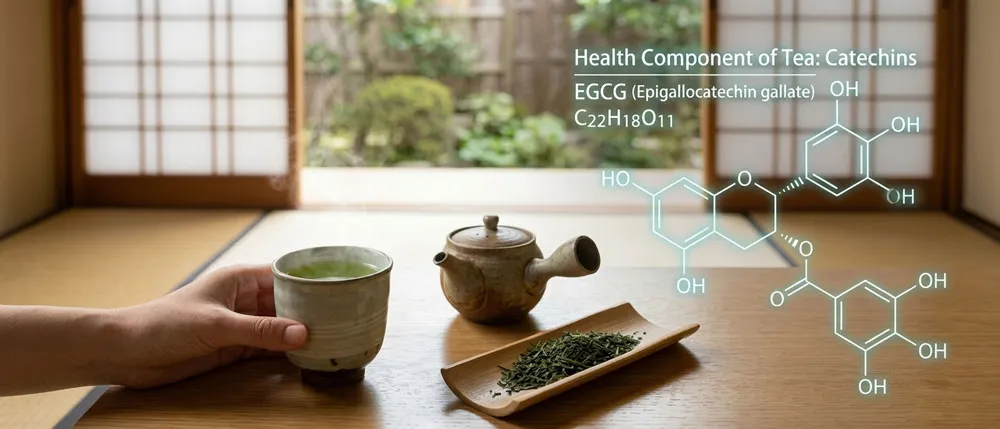
Catechin is the compound behind Japanese tea's reputation for health benefits. It's what gives tea its astringency and bitterness, but "catechin" isn't a single substance. It's actually four distinct compounds, each with its own character. Getting to know each one can open up a whole new way of enjoying tea.
The Four Main Catechins in Tea
Catechins are a type of polyphenol, once commonly called "tannin." Based on their molecular structure, the catechins in tea leaves fall into two broad groups, gallate-type and free-form, comprising four main compounds:
Catechin is often confused with caffeine, but they're entirely different compounds. Catechin is a compound mainly responsible for tea's astringency and bitterness, while caffeine also contributes to bitterness along with its alerting effect. For a detailed breakdown of caffeine content, see our tea components page.
The dominant catechin, making up roughly half of all catechin in green tea. A gallate-type compound responsible for strong astringency, it's also the most extensively studied green tea compound in the world.
A free-form catechin with a mild bitterness. It dissolves more readily at lower temperatures, such as in cold-brewed tea, than in boiling water, and has drawn research interest for a possible role in supporting the gut's immune function (per Japan's Ministry of Agriculture, Forestry and Fisheries).
A gallate-type compound with a crisp, pointed astringency. Working alongside the other catechins, it contributes to the complex, layered flavor characteristic of Japanese tea.
A colorless compound with minimal astringency, contributing a gentler note to the overall taste. When green tea beverages undergo heat processing during manufacturing, isomerized forms can appear as well, bringing the total to as many as eight catechin variants.
How Catechin Content Varies by Tea Type
Catechin content varies significantly across different types of tea, largely determined by the degree of oxidation during processing (commonly called "fermentation" in the tea trade, though it's primarily enzymatic oxidation rather than microbial fermentation). As oxidation progresses, catechins convert into other compounds, theaflavins and thearubigins, so oxidized teas contain markedly less catechin than green tea. Pu-erh tea undergoes a different, microbial fermentation process and is best considered separately from black tea here.
| Tea Type | Degree of Oxidation | Catechin Characteristics | Examples |
|---|---|---|---|
| Unoxidized | None | Made by deactivating oxidative enzymes early in processing, so catechins remain abundant | Green tea (sencha, gyokuro, matcha, etc.) |
| Partially oxidized | Partial | Oxidation converts some catechins, resulting in lower levels than green tea | Oolong tea |
| Fully oxidized | Nearly complete | Catechins convert into theaflavins and thearubigins, dropping sharply compared to green tea | Black tea |
| Post-fermented | Microbial fermentation | Undergoes fermentation by microorganisms such as molds, following a different compound pathway than oxidized teas | Pu-erh tea |
More Sunlight, More Catechin
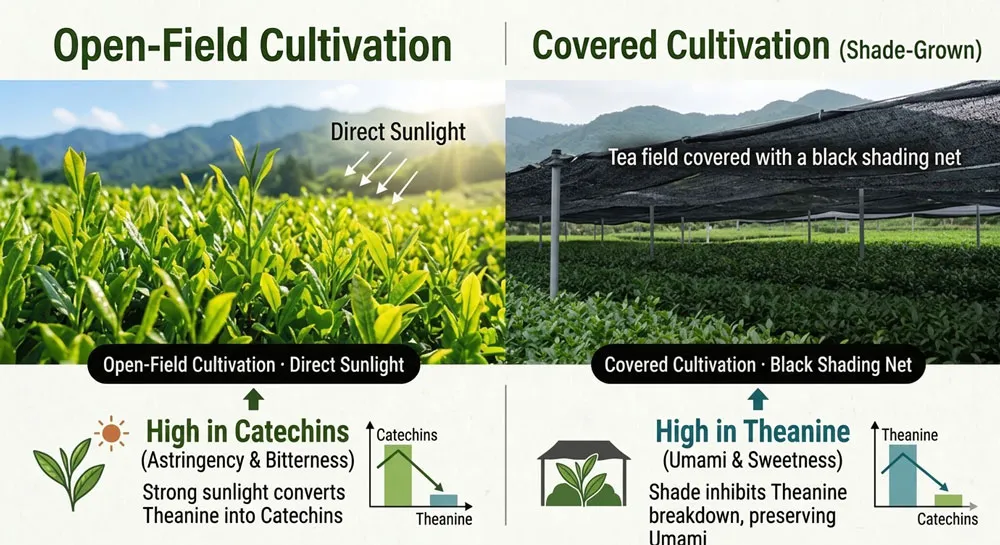
The catechin content of tea leaves depends heavily on how much sunlight the plant receives during cultivation. Theanine, the umami-producing amino acid synthesized in the roots, moves into the leaves, and when the leaves are exposed to sunlight, theanine accumulation is suppressed while catechin production is promoted. Because of this, cultivation method has a major effect on the balance of compounds in the finished tea.
☀️ Open-Field Cultivation (Higher Catechin)
Grown without shading. Sencha and bancha are typical examples. Active photosynthesis suppresses theanine accumulation while promoting catechin production, raising catechin levels. Summer harvests (the second and third flushes), which receive the strongest sunlight, tend to contain more catechin than the first flush.
🌿 Shade Cultivation (Lower Catechin)
Grown under shade covers. Gyokuro, matcha, and kabusecha fall into this category. Limiting photosynthesis keeps theanine levels higher and suppresses catechin production, producing a mellower flavor with strong umami and less bitterness or astringency.
If you want to work more catechin into your daily routine, one trick from the trade is to quickly brew a robust bancha with boiling water and make it part of your everyday habit.
How Cultivar and Region Affect Catechin Content
Catechin levels depend on more than just the type of tea. They're also shaped by cultivar and by the climate and soil of the growing region. Here are the key points worth knowing, from a specialty retailer's perspective.
📌 Harvest Timing and Catechin
Ichibancha (the first flush, or shincha) has relatively low catechin and rich umami, because theanine accumulates in the roots over winter. Nibancha and sanbancha, the second and third flushes, are harvested after strong summer sunlight and tend to contain more catechin than ichibancha (the exact difference varies by cultivar and growing conditions).
📌 Growing Altitude and Catechin
Differences in catechin content between growing regions are not determined by altitude alone. Sunlight exposure, temperature, cultivar, harvest timing, and cultivation method all play a role. As a general pattern, tea grown without shading in sun-exposed conditions tends to develop more catechin, while in misty mountain areas and regions known for shade cultivation, such as Uji and Yame, shading keeps catechin levels down and lets umami stand out.
→ Learn more about Japan's tea-growing regions
📌 Cultivar and Catechin
Yabukita, the cultivar behind most Japanese tea, is known for a good balance of catechin and umami. Yutakamidori, widely grown in Kagoshima, is an early-maturing cultivar harvested earlier than later-maturing cultivars, which tends to give it a cleaner taste. Benifuuki is a distinctive cultivar rich in methylated catechins, a different class of compound from ordinary catechins.
→ Learn more about benifuuki (Japanese)
Deep-Steamed Tea: Getting the Most Out of Catechin
For those looking to take in catechin efficiently, Minorien wholeheartedly recommends deep-steamed tea from Kakegawa.
Steamed for longer than ordinary sencha, the leaf breaks down into much finer particles. This means fine particles of the leaf itself mix directly into the cup, letting you take in more of the leaf's compounds, including catechin, than you would from whole leaves alone. Every deep-green drop reflects that difference.
Catechin in Health-Labeled Foods
Catechin is one of the most extensively studied compounds among food constituents. Here, we outline, from a mechanistic standpoint, the functions catechin is studied for in health-labeled foods in Japan. Note that the following describes catechin's role as an approved or registered active ingredient in specific products under Japan's health-food systems, not a claim about the effects of drinking tea itself.
Gallate-type catechins, including EGCG, are studied for their potential to moderate fat absorption in the small intestine by inhibiting the digestive enzyme lipase. Numerous Foods with Function Claims and FOSHU (Tokuho) products targeting body fat and visceral fat in people with an elevated BMI have been approved in Japan on this basis.
Catechin is thought to bind with bile acids, interfering with cholesterol reabsorption and potentially affecting blood LDL cholesterol levels. FOSHU products built around this mechanism exist on the market.
Catechin has been reported to potentially moderate the post-meal rise in blood sugar by inhibiting alpha-glucosidase, an enzyme involved in carbohydrate digestion. It's used in Foods with Function Claims aimed at people concerned about post-meal blood sugar.
Catechin is studied for its action on bacterial cell membranes, which may suppress the growth of oral bacteria. Products on the market carry claims related to maintaining healthy gums and suppressing compounds that cause bad breath.
The points above simply reflect the existence of research findings and approved Foods with Function Claims or FOSHU products — nothing more. They are not a claim that drinking tea itself produces these effects.
⚠ A Few Cautions About Catechin
Catechin is easy to take in through everyday tea drinking, but there are situations that call for caution.
Interactions With Medication
If you're taking any of the following medications, catechin has been reported to interact with them in ways that could affect their efficacy. Please consult your doctor or pharmacist, and take your medication with water or plain hot water rather than tea.
- Iron supplements: Catechin can bind with iron and interfere with its absorption.
- Certain blood-pressure medications (e.g., nadolol): Catechin may inhibit absorption and lower the drug's blood concentration.
- Certain lipid-lowering medications (e.g., statins): Catechin has been reported to affect the drug's blood concentration.
Source: Japan's National Institute of Health and Nutrition, "Safety and Efficacy Information on Health Foods" database, and published pharmacological research. Individual effects vary by person and circumstance — please confirm with your doctor or pharmacist.
Tips for Drinking
- Drinking a large amount of strong tea on an empty stomach can irritate the stomach lining and cause discomfort. Enjoy it with or after a meal.
- Taking catechin in concentrated form through supplements is different from ordinary tea drinking. Effects on liver function from excessive intake have been reported, so stick to the recommended dosage.
*The general characteristics and research findings described on this page do not guarantee the efficacy of any specific product. Tea is a food, best enjoyed as part of your everyday routine for maintaining health.
· Japan's Ministry of Agriculture, Forestry and Fisheries, technical information on cold-brewed green tea and catechin extraction properties
· Japan's National Institute of Health and Nutrition, "Safety and Efficacy Information on Health Foods" database (catechin functionality and drug interactions)
· Japan's Consumer Affairs Agency, public information on Foods with Function Claims and FOSHU (Tokuho) labeling
· Various published research on catechin's role in body fat, cholesterol, blood sugar, and oral health
Note: This article draws on the public information and research cited above, compiled and contextualized by the Minorien editorial team. Statements about growing regions, cultivars, and cultivation methods reflect general knowledge from our work as a specialty retailer, not specific lab analysis figures.
Want to go deeper, and have some fun while you're at it?
Professor Einstein's special lecture on "The Wonders of Tea Compounds" is now open at Ocha-nomi Women's University.
A 50-question graduation exam awaits at the end, to put your knowledge to the test!
 Shop
Shop